Archives For November 30, 1999

Is this the Age of Enlightenment? No.
Is this the Age of Reason? No.
Is this the Age of Discovery? No.

This is the Age of Measurement.

Specifically, this is the age of measurement in education where an unprecedented amount of a teacher’s time is being given over to the collection and review of data. Student achievement is being measured with multiple tools in the pursuit of improving student outcomes.

I am becoming particularly attuned to the many ways student achievement is measured as our high school is scheduled for an accreditation visit by New England Association of Schools and Colleges(NEASC) in the Spring of 2014. I am serving as a co-chair with the very capable library media specialist, and we are preparing the use of school-wide rubrics.

Several of our school-wide rubrics currently in use have been designed to complement scoring systems associated with our state tests,  the Connecticut Mastery Tests (CMT) or Connecticut Academic Performance Tests (CAPT). While we have modified the criteria and revised the language in the descriptors to meet our needs, we have kept the same number of qualitative criteria in our rubrics. For example, our reading comprehension rubric has the same two scoring criteria as does the CAPT. Where our rubric asks students to “explain”, the CAPT asks students to “interpret”. The three rating levels of our rubric are “limited”, “acceptable”, and  “excellent” while the CAPT Reading for Information ratings are “below basic”, “proficient”, and “goal”.

We have other standardized rubrics, for example, we have rubrics that mimic the six scale PSAT/SAT scoring for our junior essays, and we also have rubrics that address the nine scale Advanced Placement scoring rubric.

Our creation of rubrics to meet the scoring scales for standardized tests is not an accident. Our customized rubrics help our teachers to determine a student’s performance growth on common assessments that serve as indicators for standardized tests. Many of our current rubrics correspond to standardized test scoring scales of 3, 6, or 9 points, however, these rating levels will be soon changed.

Our reading and writing rubrics will need to be recalibrated in order to present NEASC with school-wide rubrics that measure 21st Century Learning skills; other rubrics will need to be designed to meet our topics. Our NEASC committee at school has determined that (4) four-scale scoring rubrics would be more appropriate in creating rubrics for six topics:

  • Collaboration
  • Information literacy*
  • Communication*
  • Creativity and innovation
  • Problem solving*
  • Responsible citizenship

These six scoring criteria for NEASC highlight a gap of measurement that can be created by relying on standardized tests, which directly address only three (*) of these 21st Century skills. Measuring the other 21st Century skills requires schools like ours to develop their own data stream.

Measuring student performance should require multiple metrics. Measuring student performance in Connecticut, however, is complicated by the lack of common scoring rubrics between the state standardized tests and the accrediting agency NEASC. The scoring of the state tests themselves can also be confusing as three (3) or six (6) point score results are organized into bands labelled 1-5. Scoring inequities could be exacerbated when the CMT and CAPT and similar standardized tests are used in 2013 and 2014 as 40 % of a teacher’s evaluation, with an additional 5% on whole school performance. The measurement of student performance in 21st Century skills will be addressed in teacher evaluation through the Common Core State Standards (CCSS), but these tests are currently being designed.  By 2015, new tests that measure student achievement according to the CCSS with their criteria, levels, and descriptors in new rubrics will be implemented.This emphasis on standardized tests measuring student performance with multiple rubrics has become the significant measure of student and teacher performance, a result of the newly adopted Connecticut Teacher Evaluation (SEED) program.

The consequence is that today’s classroom teachers spend a great deal of time reviewing of data that has limited correlation between standards of measurement found in state-wide tests (CMT,CAPT, CCSS) with those measurements in nation-wide tests (AP, PSAT, SAT, ACT) and what is expected in accrediting agencies (NEASC). Ultimately valuable teacher time is being expended in determining student progress across a multitude of rubrics with little correlation; yes, in simplest terms, teachers are spending a great deal of time comparing apples to oranges.

I do not believe that the one metric measurement such as Connecticut’s CMT or CAPT or any standardized test accurately reflects a year of student learning; I believe that these tests are snapshots of student performance on a given day. The goals of NEASC in accrediting schools to measure student performance with school-wide rubrics that demonstrate students performing 21st Century skills are more laudable. However, as the singular test metric has been adopted as a critical part of Connecticut’s newly adopted teacher evaluation system, teachers here must serve two masters, testing and accreditation, each with their own separate systems of measurement.

With the aggregation of all these differing data streams, there is one data stream missing. There is no data being collected on the cost in teacher hours for the collection, review, and recalibration of data. That specific stream of data would show that in this Age of Measurement, teachers have less time for /or to work with students; the kind of time that could allow teachers to engage students in the qualities from ages past: reason, discovery, and enlightenment.

…..the little mermaid’s tongue was cut out by the sea witch.”

…..the stepsisters cut off parts of their feet in order to fit into the golden shoe.”

…..the prince’s eyes were pierced by thorns after he was thrown from the tower.”

…..the children will not find the way home again, and we shall be rid of them.”

“Eugh,” says Nick. “These are horrible stories”

“They are so bloogory, …a combination of bloody and gory!” exclaims Loghan.

“Really, really gory,” adds Cassie.

We are in the middle of a fairy tale unit for my 9th grade English class which was designed so that students can begin to identify patterns in classical stories and match those patterns to the contemporary stories they read independently.

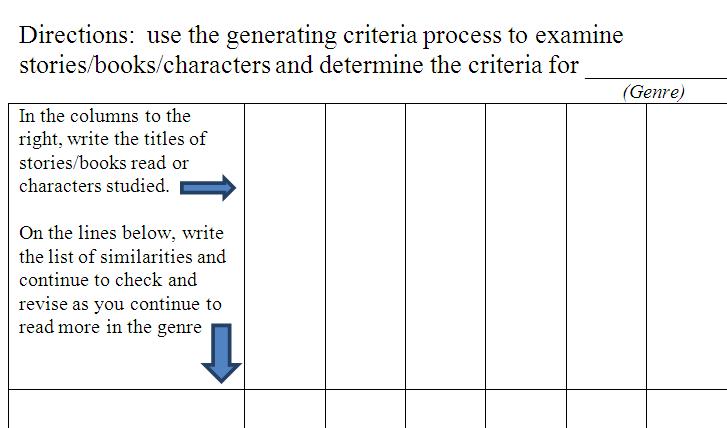
Each student has a “criteria” sheet to complete while reading the fairy tales in this unit. We share these lists of  repeated elements in fairy tales in class after reading.

Our form for generating the criteria for fairy tales


So far they have listed elements that would be expected from comparison by reading fairy tales such as castles, giants, and magic objects from their readings of Jack and the Beanstalk, Rapunzel, The Valiant Little Tailor, and Cinderella. They have also compiled a list of elements I did not expect: birds; thieves and lies; trees and bushes; and wives, not mothers. There is also a great deal of “love at first sight” discussion.

“Cinderella only saw the prince once!” says Casey. While Louisa notes that the prince is the only man Rapunzel has ever seen, “and the next time she sees him, she has a set of twins!”

Our fairy tale unit is a first exposure to the genre without the Disney treatment for many of my students, and a number of the students have commented how they think these original  fairy tales are too frightening for children. On the other hand, there are a few students who have enjoyed the dark and edgy nature of Grimms (aptly named) fairy tales. “At least the characters aren’t breaking out in song,” muttered Christopher reading The Little Mermaid.

We have no trade books or anthologies on fairy tales and have been using online texts only. Some of the texts are difficult, so we have posted resources such as the site Lit2go where most of the stories in the Andrew Lang fairy tale books and Grimm’s collection of stories have been recorded; clicking on links brings a student to the text and supporting audio.

Once the students have generated the criteria for the genre of fairy tales, we have asked them to match the fairy tale story plot to one of the  “Seven Plots in Storytelling.” Students need to explain why the fairy tale plot matches one of the seven plots in literature:

  • Overcoming the Monster
  • Rags to Riches .
  • The Quest 
  • Voyage and Return 
  • Comedy 
  • Tragedy
  • Rebirth

The “rags to riches” plot is easily understood by most students through the story of Cinderella. Similarly, they easily identify the “overcoming the monster” plot with Jack and the Beanstalk. The more tricky plots of “redemption” and “tragedy” challenge them to incorporate evidence from the story. For example, Michael suggested that the Giant’s fall from the beanstalk, “was tragic for the Giant”, but others in the class argued back that tragedy means the main character suffers the tragedy. Other students put The Little Mermaid into the “redemption” plot because, as Cassie noted, “she gave up her life to spare the life of the Prince, and she becomes immortal as a result.”

We have also had the students create original stories that address one of the seven plots using the software Storybird. The art on this website helps to inspire the story; according to the website, “Storybird reverses the process of visual storytelling by starting with the image and ‘unlocking’ the story inside.” The stories are quick to produce, but they do require Adobe Flash. So far, we have watched several “rags to riches” stories, but no student has written a “quest.” However, I am not worried about the “quest” plot because the conclusion of this fairy tale unit will bring us to the unit on Greek myths before we begin The Odyssey.

Michael was looking ahead at the syllabus and asked suspiciously, “Is The Odyssey any good?”

“Oh, yes,” I assured him, “the Odyssey is the ultimate quest!”

He looked unconvinced until I added,  “and there are parts that are really gory!”

Et Tu, Kristof?

September 15, 2012 — Leave a comment

Dear Nicholas Kristof:

Not you too? I have always looked to you as the defender of just causes; a voice of reason in times of crisis. I agreed with your passionate opening in your New York Times column Students Over Unions, September 12, 2012, noting the role of poverty as a factor in “the most important civil rights battleground” and that “the most crucial struggle against poverty is the one fought in schools.”

In adding your opinion to the Chicago teacher’s strike, you considered that today’s inner-city urban schools, “echo the ‘separate but equal’ system of the early 1950s. In the Chicago Public Schools where teachers are now on strike, 86 percent of children are black or Hispanic, and 87 percent come from low-income families.”
In this opinion piece, you also made the good points that I look for in your columns:
  • The single most important step we could take has nothing to do with unions and everything to do with providing early-childhood education to at-risk kids.
  • Teachers need to be much better paid to attract the best college graduates to the nation’s worst schools.
However, you lost me at, “How does one figure out who is a weak teacher?”
Your solution is to have schools look at value added measurements (VAM) using test data. You suggest that researchers are improving the use of VAM and that, “with three years of data, it’s usually possible to tell which teachers are failing.”
Really?
Before you put your faith in VAM, you might have perused, John Ewing’s article “Mathematical Intimidation: Driven by the Data” in the publication Notices of the American Mathematic Society.  Ewing’s thesis in the article addresses a common misuse of mathematics that “is simpler, more pervasive, and (alas) more insidious: mathematics employed as a rhetorical weapon—an intellectual credential to convince the public that an idea or a process is ‘objective’ and hence better than other competing ideas or processes.”
As the president of the organization”Math for America”, Ewing disputes the use of tests to evaluate teachers, schools, or programs, and he short lists four of the most important problems:

1. Influences. Test scores are affected by many factors, including the incoming levels of achievement, the influence of previous teachers, the attitudes of peers, and parental support. One cannot immediately separate the influence of a particular teacher or program among all those variables.

2. Polls. Like polls, tests are only samples. They cover only a small selection of material from a larger domain. A student’s score is meant to represent how much has been learned on all material, but tests (like polls) can be misleading.

3. Intangibles. Tests (especially multiple-choice tests) measure the learning of facts and procedures rather than the many other goals of teaching. Attitude, engagement, and the ability to learn further on one’s own are difficult to measure with tests. In some cases, these “intangible” goals may be more important than those measured by tests.

4. Inflation. Test scores can be increased without increasing student learning. This assertion has been convincingly demonstrated, but it is widely ignored by many in the education establishment. In fact, the assertion should not be surprising. Every teacher knows that providing strategies for test-taking can improve student performance and that narrowing the curriculum to conform precisely to the test (“teaching to the test”) can have an even greater effect. The evidence shows that these effects can be substantial: One can dramatically increase test scores while at the same time actually decreasing student learning. “Test scores” are not the same as “student achievement”.

In pointing out the flaws of VAM in testing, Ewing concludes:

“Of course we should hold teachers accountable, but this does not mean we have to pretend that mathematical models can do something they cannot. Of course we should rid our schools of incompetent teachers, but value-added models are an exceedingly blunt tool for this purpose. In any case, we ought to expect more from our teachers than what value-added attempts to measure.”

Ultimately, Ewing determines the tool, the data from a single metric, used to measure teacher performance is fundamentally flawed. I ask you to consider what other profession evaluates on a single metric?

Evaluate performers in any other profession and note the number of metrics used to determine success. Athletes have pre-season games, games, playoffs all of which give important data to determine improvement over time. Multiple industries release profit statements quarterly while parsing through the tremendous amount of targeted consumer data now available. Lawyers, doctors, and other professions are ranked not by single cases, but by professional performance accrued case by case. Government agencies use multiple measurements to determine progress in various sectors (employment, demographics, investments,etc) and provide monthly reports to determine progress; even the presidential race has a primary before the election. Yet there are those who would want teachers to be evaluated using the metric of a single test, taken one day out of one school year.

The single metric test is given state by state to measure growth in skills and subject area content in reading, writing, math and science. Elementary school teachers and teachers at the high school in these subject areas receive the most scrutiny. Many state standardized tests are given at specific grade levels. In other words, in my state of Connecticut, teachers in 5th, 8th or 10th grade who teach one of the “core” classes carry a different evaluation burden; their test results are widely publicized as the school ranking against other schools. Elective teachers (art, PE, music, foreign language) or “off-year testing” teachers do not receive the same level of examination by the public.

However, I do not advocate increasing tests at every grade level or in every subject in order to even the playing field. You write that the reliance on tests and VAM “are stirring skepticism and anger among teachers” because the evaluation system is being created by those who do not have authentic or extensive classroom experience. Instead, the evaluation system is being handed over in large part to the testing industry, and that testing industry lives in an incestuous relationship with publishing and educational “support” developers. The testing industry proclaims a school system’s success by evaluating data from a test, but within that same industry are multiple businesses that profit from a a school system’s need to purchase programs and materials they promote as necessary to pass the standardized test. “Failing the standardized tests? You need our reading/writing/math/science program!”

Before you hop onto the bandwagon with those advocating a one-test metric, consider how this opinion piece “Students over Unions” differs in both research and sentiment from your columns that bring national attention to the poor and the disenfranchised. So different was the tone of this piece as to have a caught the attention of several other writers who called you out specifically: Sarah Jaffe from Truth Out Five So-Called Libreral Pundits that are Attacking Teachers; and Education Week contributor Larry Ferrlazzo on his blog “When Bad Ideas Happen to Good Columnists” to name two.Valerie Strauss from the Washington Post in Why Rahm Emanuel and The New York Times are Wrong about Teacher Evaluation  also found and incorporated the Ewing argument in explaining the lack of union support from your paper. You even got into a Twitter-tiff with education advocate Diane Ravitch http://Twitter.com/DianeRavitch

Ultimately, I am confident that you would not want one column, specifically this one column, to be used to define you for an entire year.  You would not want one metric to measure your success as writer for the New York Times. You would not want one single opinion piece be used as measurement in order to evaluate your annual performance.

Well, neither do teachers.

Smartblogs recently ran a post by Bill Ferriter titled “Reading Nonfiction is not Optional ” where he argued that there is too much fiction in a student’s reading diet. “The sad truth,” he wrote, “is that fiction still dominates the literacy lives of young readers. Whether they are wrapped up in fantastic exploits written by guys like Rick Riordan or churning through the latest release in the hottest new vampire series, today’s kids rarely make room for nonfiction in their book bags.”

Sad truth? Why is this a “sad truth”? What is wrong with reading fiction? Fiction, like its counterpart non-fiction, offers our student readers valuable life lessons. For example, in an online article in guardian.co.uk September 7, 2011 Reading Fiction ‘Improves Empathy’, Study Finds, Professor Keith Oatly at the University of Toronto who studies the psychology of fiction reports that:

“I think the reason fiction but not non-fiction has the effect of improving empathy is because fiction is primarily about selves interacting with other selves in the social world. The subject matter of fiction is constantly about why she did this, or if that’s the case what should he do now, and so on. With fiction we enter into a world in which this way of thinking predominates. …. In fiction, also, we are able to understand characters’ actions from their interior point of view, by entering into their situations and minds, rather than the more exterior view of them that we usually have.”

Annie Murphy Paul noted the same study in her article in The New York TimesYour Brain on Fiction (3/17/12) writing that, “Brain scans are revealing what happens in our heads when we read a detailed description, an evocative metaphor or an emotional exchange between characters. Stories, this research is showing, stimulate the brain and even change how we act in life.” Apparently, our brains cannot differentiate between the fictional experience and the real life experience, “in each case, the same neurological regions are stimulated.” Furthermore, the simulation of social experience in fiction through a character’s point of view  helps prepare our brains for real-life social interactions.

In other words, while the genre of non-fiction may be the recording of real life, the genre of fiction is critical in preparing readers for real life.

In his post, Ferriter also quoted young adult (YA) writer Walter Dean Myers:

“We all know we should eat right and we should exercise, but reading is treated as if it’s this wonderful adjunct…We’re still thinking in terms of enticing kids to read with a sports book or a book about war. We’re suggesting that they’re missing something if they don’t read but, actually, we’re condemning kids to a lesser life. If you had a sick patient, you would not try to entice them to take their medicine. You would tell them, ‘Take this or you’re going to die.’ We need to tell kids flat out: reading is not optional.”

Ferriter’s paraphrase of Myers’s statement, the title of his post, “Reading Nonfiction is not Optional,” strikes the wrong tone. Myers, a writer of both YA fiction and non-fiction, did not specify as to the genre he endorsed for student reading. Myers was advocating reading, period. Both fiction and non-fiction are critical to our students’ growth and development, not one genre at the expense of another.

Independent reading means a student can choose to read non-fiction OR fiction

Yes, the English Language Arts Common Core State Standards (ELA CCSS) call for an increase in non-fiction. The authors of the ELA CCSS created a little chart on page 5 of the ELA CCSS that notes that students should be reading 70% non-fiction and 30% fiction by grade 12. But this is not the ratio for reading in an English Language Arts classroom. That is the ratio for a whole school curriculum.

I am particularly sensitive to the increasing number of attacks on fiction and the need to reducing fiction from the English classroom. Ferriter’s post makes a similar argument and could be associated with the myth that “English teachers will be asked to teach non-fiction”. This myth is directly repudiated in the ELA CCSS document:

“Fact: With the Common Core ELA Standards, English teachers will still teach their students literature as well as literary non‐fiction. However, because college and career readiness overwhelmingly focuses on complex texts outside of literature, these standards also ensure students are being prepared to read, write, and research across the curriculum, including in history and science. These goals can be achieved by ensuring that teachers in other disciplines are also focusing on reading and writing to build knowledge within their subject areas.”

In other words, reading must be offered in every discipline, students must read across the curriculum.While Ferriter’s Reading Nonfiction is Not Optional makes the important point that all teachers are responsible for modeling reading, he oversteps when he says, “If you want students to love nonfiction — and you should considering the important role that nonfiction plays in learning — you really do need to stop spending all of your sustained silent reading time figuring out what’s going to happen next to Origami Yoda.” Good SSR programs allow for independent choice in any genre by students. What Ferriter could have suggested that the expansion of SSR to other disciplines would increase reading of non-fiction while having the additional benefit of satisfying the ELA CCSS.

Of course, I often hear arguments from teachers in other disciplines moaning, “What do I drop out of my course to include reading?” which could be interpreted as the reason why the authors of the ELA CCSS felt the need to develop reading and writing standards for History, Social Studies, Science and the Technical Areas. These disciplines need to step up the reading in their classrooms.

But who said reading non-fiction was an option? I can assure Ferriter that English/Language Arts teachers are dedicated to improving student reading. They are not hung up on genre, but when they teach fiction, English/Language Arts teachers are teaching their subject matter. The adoption of the ELA CCSS means that all disciplines must offer for opportunities to share their subject matter. To re-frame Ferriter’s argument to align with the new standards, reading non-fiction in every classroom is not an option, and reading non-fiction in an English/Language Arts classroom can be a choice. After all, that growing body of research shows that fiction is just as important as non-fiction for our students, including what happens in Origami Yoda.

Be vewy, vewy quiet….we’re reading!

Our new block schedule at Wamogo High School has made the school much quieter. We have alternating days, four periods of 85 minute classes; the traffic in the hallway is less, and, thankfully, so are the announcements. This quiet provides an excellent environment for us to continue our practice of silent sustained reading (SSR) at all grade levels, 7-12. We embarked on our SSR program two years ago, and we have noted both the anecdotal success with the program through participant surveys and the reading scores on the CMT/CAPT (State of CT mandated tests).

There are a number of texts on the incorporation of an SSR program in a language arts classrooms. Janice Pilgreen’s book (2000) The SSR HandbookHow to Organize and Manage a Sustained Silent Reading Program has an eight point checklist for successfully implementing SSR.

Using Pilgreen’s checklist (her suggestions in red), here is an explanation of how Wamogo is implementing the SSR program this year:

  • “Students need to be flooded with reading materials.”Our classroom libraries of whole class reads and independent reads are full. We have several carts that we can roll into classrooms of independent reading materials. Some carts are dedicated to specific grade levels or classes. For example, our Memoir class have a cart full of memoirs of all reading levels that students can select. Our school library is one of the few in the state to offer Overdrive® to all of its schools. Region 6 students and staff can easily download ebooks to a variety of devices from our Overdrive® catalog with over 15,000 titles. Students and staff can borrow free ebooks and read them on their iPod, iPad, laptop, Kindle or Nook. Creating a flood of reading materials is discussed also in Kelly Gallagher’s book Readicide. 
  • Appeal: The reading materials should be geared toward the interests of the students who are reading them.” We are sensitive to the wide variety of interests in our school. Many of our students are vocational agriculture students who are interested in non-fiction selections. We include all genres: manuals, graphic novels, historical non-fiction, fiction (YA titles) in trying to find books that interest our students.
  • Conducive Environment: The physical setting should be quiet and comfortable.” The new block schedule has benefitted the SSR program in an welcomed level of quiet in the school day. We do have the students read at their desks; we do not have “comfy chairs”.
  • Encouragement: Students need supportive adult role models who can offer assistance in locating reading material.” Our English Department teachers read with the students. We read the books during SSR so that we can make recommendations and discuss books with our students. Our amazing library media specialist comes in and gives book talks. She has also successfully incorporated popular author booktalks, in person or on SKYPE, with popular writers such as Neil Schusterman, Gordan Korman,and  Laurie Halse Anderson. (I am hoping for a Jon Szeiska interview one day *hint-hint*)
  • Staff Training: SSR doesn’t just happen; the staff of a school should be well versed in the goals and procedures used at the school.” Our department has seen the benefits of the SSR program, and we support each other with strategies to make the program work for us. There are teachers who use SSR time to confer with students, however, we found conferencing  distracted other readers. We also discuss the best times to implement an SSR activity in a block period, and how to measure results. 
  • Non-accountability: This is perhaps the most controversial factor. Pilgreen found that students read more, and had more positive attitudes toward reading, when book reports and such were not required.” In today’s data driven classrooms, this is a difficult, even risky, decision. In 9th grade, we do require one book review per quarter to be placed on a shared class blog, and we do require students to read more than one book per quarter. I also record the start page and the end page (students provide this number) as a way of keeping track of their progress. But, there are no other assessments of their independent reading.
  • “Follow-up Activities: Pilgreen found that follow-up activities such as conversations about books read by students or the teacher encouraged other to try them out.” We do spontaneous book talks. “Anyone reading a good book?” I will ask, “Any recommendations?” Students will share their reactions to a book when asked.
  •  “Distributed Time to Read: A common error made by schools new to SSR is that they have one long SSR period a week, rather than shorter periods that occur daily. Pilgreen found that successful programs have students read for fifteen to twenty minutes daily.” We have found that 15-20 minutes of reading time is ideal. On an alternating block schedule, this gives our students 30-60 minutes a week of quality reading time.

A classroom book cart in Grade 9 with high interest titles

Robert Marzano’s book Building Background Knowledge for Academic Achievement, ASCD, (2004) references Pilgreen’s eight steps; he  suggests a 5-Step Process for implementing SSR:

Step 1: Students identify topics of interest to them.
Step 2: Students identify reading material.
Step 3: Students are provided with uninterrupted time to read.
Step 4: Students write about or represent the information in their notebooks.
Step 5: Students interact with the information.

The major difference between Pilgreen and Marzano is the use of a notebook (step 4) for recording which we may incorporate this year in having students respond to prompt. These prompts are centered on story elements (“What similarities do you notice between your character and the archetypal character we study who is on a journey?”) . Our students are using writing notebooks for free-writes (front to back) and notes/vocabulary/grammar (back to front). Their first assignment was to “decorate” the notebooks, and already there are some enthusiastic participants for both decorating and free-writes!Finally Doug Fisher and Nancy Frey make a case for including SSR as a means to acquire content vocabulary in their book  Word Wise and Content Rich, Grades 7-12: Five Essential Steps to Teaching Academic Vocabulary, Fisher and Frey consider SSR as a means to contribute to gains in both background knowledge and vocabulary.

One more reason to implement SSR? The world is noisy. Students have their individual soundtracks plugged into their ears wherever they go; all venues from public transportation to shopping to sporting events have soundtracks; phone ring tones abound. There is a cacophony of sound in a student’s brain during the waking, perhaps even the sleeping, hours.The daily 15-20 minutes we offer students to read may be the only 15-20 minutes in a day where they are forced to be quiet. SSR allows them to absorb information without distraction. Ultimately, SSR at every grade level provides the opportunity for students to shut out the noise of school; SSR teaches our students to be vewy, vewy quiet. They’re reading.

Wamogo High School (Region 6)  in Connecticut finished four days of teacher driven professional development. There were a few “requested sessions” which were organized to address concerns about the upcoming block schedule; we are moving from a sequence of 38-45 minute periods to alternating days of 80 minute blocks. The question came up, “What plans can a teacher leave a substitute teacher for this length of time?”

I suggested that a lesson plan that incorporates film is easy to prepare in advance, so I organized the following links that teachers can use to prepare a substitute lesson that incorporates film.

The substitute teacher may have students who think they have the “day off”, but a film lesson organized with a written reflection can be an effective way to promote new learning.

Film lessons are popular with substitute teachers. They are usually engaging, and they are easy to implement as long as the substitute can access the video online or operate the hardware to run a hard copy of the video.

Video/film lessons also meet many of the Common Core Standards as stated in the Overview for the ELA Standards: “Just as media and technology are integrated in school and life in the twenty-first century, skills related to media use (both critical analysis and production of media) are integrated throughout the standards.”

Our school has a subscription to Discovery Education which is jammed packed with digital content: film clips and prepared lesson plans are available for every grade level. However, other school systems may not have this resource.

The following free websites were reviewed in the presentation for teachers to use in order to find videos, lesson plans to use with videos, and/or worksheets that can be completed by students watching videos.

One major source to start looking for all video materials is the updated Edudemic 100 Video Sites on the Edudemic.com website.This website is organized with sub-headings General; Teacher Training; Science Math & Technology; History, Arts and Social Sciences; Lesson Planning; Video Tools and true to its name there are 100 sites, each rich with links to videos of all lengths in all subjects.

To accompany a selected film or video, I strongly recommend students have a writing assignment. The writing assignment can be in a variety of formats: notes, critical analysis, or reflection. I am not a fan of the worksheet, but substitutes benefit from a well-designed worksheet that students can complete and turn in at the end of class. For that reason, I located a number of websites that can be used to either develop a worksheet or websites that have worksheets already prepared:

Video documentaries are also popular; since these are often shorter than a feature length film, many can be run during one block period. A note of caution: several of these videos will need to be vetted to assure content appropriate materials are used. Many of the video clips on these sites are current and can be associated with news articles to use to supplement the viewing as a comparison or a contrast. 

The Oscars.com website offers a generic documentary worksheet. This prepared sheet is organized around political discourse, but the sheet has questions that can be used with any documentary. 

The Ted Talks website describes the numerous video presentations as “Ideas Worth Spreading.” TED began in 1984 as a “conference bringing together people from three worlds: Technology, Entertainment, Design.” There are very entertaining videos on every subject, but most recently, there has been a new category devoted to education TED-ED. These short film clips at  http://ed.ted.com/ are offered with interactive quizzes and writing prompts.

My Film and Literature class used many of the lessons off the Film English blog devoted to film and English Language Learners (ELL) http://film-english.com/. The lesson plans are very detailed and involve critical thinking skills that can be used outside of the ELL classroom as well.

Our English Department has been phasing out the department’s DVD library; so many DVDs were scratched or went missing during the school year. We now use commercial “instant streaming” websites where we can purchase videos for safekeeping “in the cloud”. Unfortunately, this means that one of the best features used for showing a film, the closed-captioning feature, is not available. If we cannot locate a film through an “instant streaming” service, we check with OpenCulture.com http://www.openculture.com/freemoviesonline which has hundreds of movies available. Some are subtitled in English; most are classic films. Suppose the DVD case is empty? Teachers can check here to see if the film is available for free on this site.

Finally, the “motherlode” of film lesson plans is on the NYTimes Learning Network website. This is a one stop shopping for plans website (no subscription required) with lessons written by “[freelance] educators with deep and broad experience in the classroom and in curriculum development. They work with the editors, Katherine Schulten and Holly Ojalvo, who are also longtime educators, to develop the lessons.” The lessons are thorough, tied to standards, and so easy to follow that a sick teacher need only browse for a few minutes to find a lesson, film or otherwise, that can connect to a discipline.

This year, the 80 minute time block is new for our school and for our substitutes, and this longer class period demands even more attention to preparation. No teacher or administrator wants to lose 80 minutes (X) times the number of students in the classroom; do the math- 20 students in a class X 80 mins = 1600 educable minutes! A film/video lesson should not be offered as babysitting, but rather a lesson that extends learning in another medium. This quick presentation of information was designed to help teachers design lessons that can be easily implemented by a substitute teacher and meaningful for the students.  A well-designed film lesson can be effective even if the classroom teacher is not the one clicking the “play” button.

Teachers Built “It”

September 4, 2012 — Leave a comment

The claim “I built it” is being tossed around this political season.  I am not a fan of the unspecific pronoun “it”, but as “it” in this context stands for any one of a number of diverse businesses that power our nation’s economy, the inclusive, ubiquitous pronoun will have to serve.

While I agree that the success of our nation is due in large part to those who “built it [businesses]” in the past and to those individuals who will “build it [businesses]” in the future, I feel the need to point out that there is one profession that has more claim to this catch phrase then others. If America is a world power today because of those who “built it,” the individuals who “built it” are teachers. For example:

  • Teachers have “built it” by  teaching the reading and comprehension of texts in differing levels of complexity;
  • Teachers have “built it” by teaching formal and informal writing to communicate;
  • Teachers have “built it” by explaining the essentials of numeracy;
  • Teachers have “built it” by presenting the basic  laws of motion, gravity, and energy;
  • Teachers have “built it” by clarifying the organization of elements which compose the organic and inorganic on the planet;
  • Teachers have “built it” by explaining  science of colors and techniques of expression or the science of sound and musical techniques of expression or the science of drama and the techniques of performance;
  • Teachers have “built it” by presenting instruction in other languages to promote global understanding;
  • Teachers have literally  “built it” with hands-on lessons in engineering and industrials arts.
  • Teachers have “built it” by presenting lessons of history; the lessons of economic principles to budding businessmen, strategic principles to future military leaders, and political science to future politicians;
  • Teachers have “built it” by instilling an appreciation for civics and law to our nations’ citizens and to those who directly interpret and defend our Constitution.

Teachers at every grade level, teaching youngsters in kindergarten to teaching adults in graduate school, have had a hand in building our nation’s skills and developing our national brain trust. Teachers in all schools, public and private, have dedicated time and energy in the passing of information from one generation to the next. Teachers of all disciplines have shared their expertise in the hopes of building a better society.

Granted, not all teaching has been successful. There have been teachers that have missed steps in the building of knowledge; students may not have gained information that would have been beneficial. Some lessons have ended in failure, and despite best efforts, statistics on literacy for American adults vary over 80%. There is more that can be done to improve education, and so there are teachers working to “build” a better education system for all citizens.

Teachers are “building it” using the Bloom’s taxonomy of knowledge, comprehension, application, analysis, synthesis, and evaluation. Teachers are “building it” with an appreciation for the different learning styles of students from the verbal-linguistic to the  logical-mathematical; from the visual-spatial to the bodily-kinesthetic; from the interpersonal to the intrapersonal, and from the musical to the naturalistic.

In classrooms everywhere, whether a student is seated in an august university or in a home school kitchen, there are teachers who are at this very moment teaching students how to “build it”, whatever “it” might be. In each of these classrooms, the “building on” knowledge and understanding is critical to the success of what will be “built” in the future.

The phrase, “I built it” might even have its origins in the classroom. How often has teacher affirmed a student’s success with “You did it!” or “Look what you did!” rather than self-serving “Look what you just learned because a teacher taught you.”

Yes, our nation has been blessed with  inventors, industrialists, and entrepreneurs who can claim that they “built” successful economic enterprises. Yes, our nation has great artists, philosophers, and communicators who “built” our formidable culture.Yes, our nation is rich with independent and collaborative thinkers who now “build” pathways for our future.

But do not forget that there have been the teachers who “built it”in the classrooms where “it” stands for intellectual curiosity, understanding, and knowledge. The “it” that teachers build is education.

I am glad there are so many Americans of every political persuasion who proudly can state, “I built it!” Just so they remember that they “built it” because their teachers taught them how.

Going back to school means that teachers and students will confront two philosophical statements. One statement is the school’s mission statement that quite literally confronts them as they enter a school building. The second statement is the statement of purpose for the Common Core State Standards (CCSS) that currently guides the curriculum for K-12 teachers in states that adopted the CCSS.

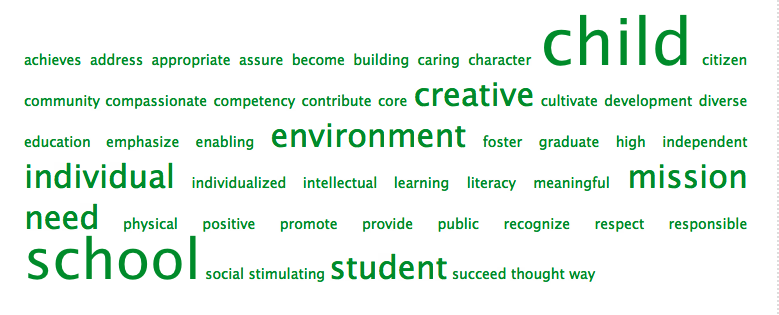
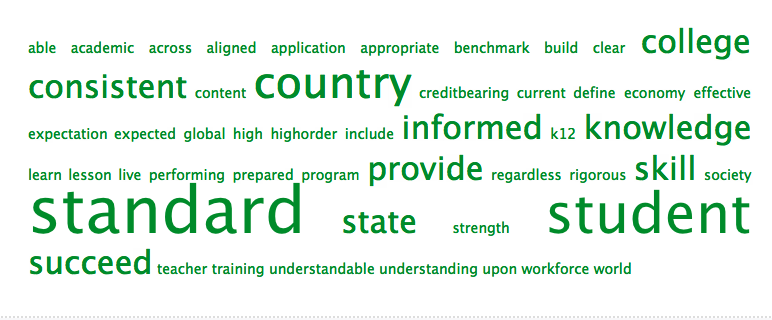
Here is an interesting exercise. Below, there are three randomly selected school mission statements plus the mission statement from my own school, Wamogo Middle/High School. These statements are generic enough to be for any grade level; they could be for any school.  You could test your school’s mission statement as well. I pasted the combination of these four statements into a Wordsift.com word cloud generator that highlights the more frequently used terms. (illustration below)

_______School recognizes that each child is an individual; that all children are creative; that all children need to succeed. Therefore, _______ School respects the individual needs of children; fosters a caring and creative environment; and emphasizes the social, emotional, physical, intellectual development of each child.

Our mission at ____ High School is to provide individualized education that addresses students’ unique learning styles, cultivates independent thought, and promotes the building of character, enabling them to contribute to their communities in meaningful and positive ways.

The mission of _______Public Schools is to assure that, within a nurturing and stimulating environment, each of our diverse students and graduates achieves literacy and appropriate core competencies, and becomes a responsible and compassionate citizen.

The mission of Wamogo is to educate all students in a challenging, disciplined, and supportive environment. In cooperation with students, parents, and community members, we seek to empower students to be lifelong, independent learners and contributors in a diverse and ever changing society. (Wamogo Middle/High School)

Next, I selected an an excerpt from introduction that explains the purpose and goals of the Common Core State Standards; the text selected was about the same length as the mission statements. I pasted the excerpt  into another Wordsift.com word cloud generator that highlights the more frequently used terms. (illustration below)

The standards are informed by the highest, most effective models from states across the country and countries around the world, and provide teachers and parents with a common understanding of what students are expected to learn. Consistent standards will provide appropriate benchmarks for all students, regardless of where they live.

These standards define the knowledge and skills students should have within their K-12 education careers so that they will graduate high school able to succeed in entry-level, credit-bearing academic college courses and in workforce training programs. The standards:

  • Are aligned with college and work expectations;
  • Are clear, understandable and consistent;
  • Include rigorous content and application of knowledge through high-order skills;
  • Build upon strengths and lessons of current state standards;
  • Are informed by other top performing countries, so that all students are prepared to succeed in our global economy and society; and
  • Are evidence-based.

What is immediately  apparent is that the language in the school mission statement Wordsift wordcloud is very different than the language in the CCSS Wordsift wordcloud. For example, the words education and school do not appear in the CCSS wordcloud; the words skill and knowledge do not appear in the school mission statements wordcloud. The word standard is emphasized in the CCSS wordcloud; the  word child is emphasized in the school mission statement wordcloud. The word career is in the CCSS workcloud; its counterpart is citizen in the mission statement wordcloud. The words college, consistent, informed, provide dominate the CCSS wordcloud. The words creative, environment, individual, need dominate the school mission statement wordcloud. The word student is one of the few emphasized overlapping vocabulary choices. Neither mentions 21st century skills.

I am not a fan of school mission statements. They are usually written by committee, and each successive rewrite makes the language in the statement generalized or vague or bland; I believe that “please all, please none” is the problem with a mission statement. However, one would hope that the differences in diction between a generic mission statement and the Common Core would not be so striking. Ultimately, these two ideas contribute to a common outcome; there should be some commonality other than an emphasis on the word student.

Additionally, the difference is not only one of word choice, but also one of tone. The verbs assure, become, contribute, cultivate, foster, promote, and recognize in the school mission statement wordcloud differ in tone from the few verbs  build, define, learn, live, and graduate in the CCSS wordcloud. The adjectives caring, compassionate, diverse, individualized, stimulating in the school mission statement wordcloud differ in tone from aligned, appropriate, effective, expected, higher order, global and rigorous as adjectives in the CCSS wordcloud. The words social, public and character are not in the CCSS wordcloud; the words economy, benchmark and workforce are not in the mission statement wordcloud. Perhaps it is not a surprise that the language of the mission statements is more sensitive or empathetic in tone than the businesslike language of the CCSS.

My random selection of the three school mission statement plus the statement of my own school cannot possibly speak for all school mission statements. There may be mission statements that have vastly different vocabulary.  Regardless, this imperfect comparison highlights a gap in the language of these mission statements and the language of the CCSS. The goals and purpose of the Common Core should have something in common with goals and purpose of a school.

To some educators, the Common Core State Standards (CCSS) could be consider the work of control freaks. To other educators, the CCSS could be interpreted like the line spoken by Captain Barbossa in Pirates of the Carribean, “the code is more what you’d call ‘guidelines’ than actual rules.”

At my core I am a control freak with strong tendencies towards being a perfectionist. However, 21 years of teaching in real classrooms with real students has informed me to deal with these tendencies in order to achieve realistic educational outcomes. I must teach the student in front of me, not the student I want to teach. I must deal with each student’s  particular mix of strengths and weaknesses. As I deal with that reality, I have learned to hand over more control to my students in their choice of reading and their choice to demonstrate understanding at each grade level.

When I give up control, the results are often unexpected, occasionally raw, and generally more than I planned every year. However, this  process is messy and individualized which is probably why policymakers cannot wrap their neat little statements around what really happens in a classroom. I have learned teaching  in the classroom is more like following the guidelines rather than following a strict set of rules.

But there are those policymakers who claim that following the rules is more important. One argument for this ideology recently was posted by Kathleen Porter-Magee who argues for text complexity in a blog post on the Thomas B. Fordham Institute website, “Common Core Opens a Second Front in the Reading Wars” (8/15/12):

But the Common Core ELA standards are revolutionary for another, less talked about, reason: They define rigor in reading and literature classrooms more clearly and explicitly than nearly any of the state ELA standards that they are replacing. Now, as the full impact of these expectations  starts to take hold, the decision to define rigor—and the way it is defined—is fanning the flames of a debate that threatens to open up a whole new front in America’s long-running “Reading Wars.”

Her missive across the bow of education uses the motif of war, the subject of a 2007 post “Reading Wars Redux”  which scratches at the scab of the phonics vs. whole language debate associating a student’s “natural” selection of a text with whole language; a student’s reading choice does not fit with scientifically-based reading research reading programs. Porter-Magee references that argument as part of a strict adherence to text complexity as outlined in English Language Arts Standard 10 and the complexity determining software.

The ELA Standard 10’s arc begins in kindergarten where students will, “Actively engage in group reading activities with purpose and understanding.” By grades 11-12, students should, “Read and comprehend literature, including stories, dramas, and poems, in the grades 11–CCR text complexity band proficiently, with scaffolding as needed at the high end of the range.” Determination of a text’s rigor is suggested through six different computer programs that factored in the research study: ATOS by Renaissance Learning; Degrees of Reading Power® (DRP®) by Questar Assessment, Inc.; Flesch-Kincaid; The Lexile® Framework For Reading by MetaMetrics; Reading Maturity by Pearson Education; SourceRater by Educational Testing Service; and the Easability Indicator by Coh-Metrix. These educational commercial enterprises (only the Flesh-Kincaid is in the public domain) are the means to determine what Porter-Magee argues is critical to developing rigor in our classrooms.

I would argue differently. A curriculum is not rigorous because of a text; a curriculum is rigorous because of what a student does with a text. Assigning students a rigorous text, say Narrative of the Life of Frederick Douglass, an American Slave in grades 6-8 does not mean the curriculum is rigorous. However, a curriculum with a lesson that has students read the narrative, compare this autobiography with  narratives from former slaves that were recorded in the 1930’s as part of the Federal Writers’ Project, and then have students conduct research on slavery and tell a story based on their findings could be considered rigorous. This lesson would be an example of a whole class read.

This lesson, however, does not promote a critical learning experience. The lesson does not address a student’s love of reading. Students may enjoy the Autobiography of Frederick Douglass, but I would venture that few 6-8th graders would choose to read the text independently. That is why there needs to be a place in every curriculum for independent choice where students may read above, on, or maybe even below grade level. Teachers are educating students so that we will be a nation of readers. My experience in the classroom informs me that handing a low level reader a complex text for close reading does not lead to a love of reading. Moreover, forcing rigor is not authentic; many adults do not choose complex texts, in fact, many admit to avoiding text complexity as a result of being force fed the literary canon in a misguided attempt to enforce rigor.

The ELA CCSS itself does not require the forced rigor that Porter-Magee implies. Appendix A of the ELA CCSS “Key Considerations in Implementing Text Complexity” notes the flexibility that educators have:

The tools for measuring text complexity are at once useful and imperfect. Each of the tools described above—quantitative and qualitative—has its limitations, and none is completely accurate. The question remains as to how to best integrate quantitative measures with qualitative measures when locating texts at a grade level. The fact that the quantitative measures operate in bands rather than specific grades gives room for both qualitative and quantitative factors to work in concert when situating texts. The following recommendations that play to the strengths of each type of tool—quantitative and qualitative—are offered as guidance in selecting and placing texts.

Quantitatively, a book may be at the level for a grade 10 student; qualitatively, the book may be too mature in theme, or the student may need additional support. The ELA CCSS recognizes this difference. That is why Appendix A offers guidelines rather than rules; suggested texts rather than required reading.

This is not a war. This should not be a skirmish. The ELA CCSS can be met with a blend of independent reading and complex texts. (see my earlier post  on blending independent student selected reading with whole class novels) Porter-Magee’s hyperbolic statement about a second front in a reading war is  one of ideology not reality. Teachers, even the most controlling, have an understanding of how text complexity can be balanced in the classroom today with the real students in front of them. Policymakers who see rigor through the addition of texts are distanced from the classroom. Magee-Porter’s post should be met with the same level of criticism as given to the pirates of the Caribbean, “You’re teachers. Hang the code, and hang the rules. They’re more like guidelines anyway.”

English teachers, defend literature in the classroom!

I teach English, and I am feeling a little defensive lately. In the past week, I have had two separate “literature-threatening” incidents.

The first came from a reader to an opinion piece I wrote that was featured in Education Weekly, 21st Century Students Need Books, Not Textbooks. The responder was repeating the myth that English classrooms need to abandon teaching literature in favor of teaching math and science texts:

“You need to look at the Common Core ELA [English Language Arts] standards and realize you now have a responsibility to teach reading and writing for STEM subjects. That is why this discussion is so wrong. Start reading math and science textbooks and start teaching what your students need, not what you love. I learned early on: the most boring subject is the world is another person’s hobby. Your hobby is reading “literature.” Your students need to learn to read and write STEM [science, technology, engineering, and math] topics, and those are found in textbooks. PERIOD!!”-Ebasco

This kind of response comes from the mistaken interpretation that the 70% of informational texts suggested by the Common Core State Standards (CCSS) need to be taught in English class; even the CCSS devotes a clarification to this on page 5 of their document in a footnote. Instead, reading is to be a critical part of all disciplines, generally 70% informational texts in all subjects and 30% fiction in English classrooms. However, English teachers can assign informational texts just as history/social studies can assign historical fiction; the genre assignment is fluid. An entire section of the ELA CCSS titled “Reading in History/Social Studies, Science, Math and the Technical Areas” is a guide devoted to improving the reading and writing standards in all disciplines. The push for reading informational texts is certainly a result of STEM, but literature is not being jettisoned out of the curriculum because it is a “hobby”.

Indeed, the benefits of reading literature is rooted in the second of the “literature threatening” incidents, in a WNYC Schoolbook blog post a piece titled Never Mind Algebra, Is Literature Necessary?  In this post, Tim Clifford made a compelling case regarding the stripping of literature from English classrooms in favor of Common Core, and again, the roots of this anti-literature movement are found in mistaken interpretations of the CCSS.

Clifford began his post with a multiple choice quiz based on the following quote:

“Now, what I want is facts. Teach these boys and girls nothing but facts. Facts alone are wanted in life. Plant nothing else, and root everything else out.”

Clifford posed the question “Who said the above?” and then offered three responses:

a. Bill Gates, Microsoft founder and educational gadfly
b. Michelle Rhee, staunch proponent of standardized testing
c. David Coleman, author of the Common Core standards

Then he offered the real answer,
d. Thomas Gradgrind, a fictional character created by Charles Dickens in the 1854 novel Hard Times.

The quote expressed the publicized sentiment of standardized testing advocates David Coleman, Bill Gates and Michelle Rhee. (I had chosen David Coleman as my answer). In discussing the correct answer, Gradgrind, Clifford explained that Dickens’s character was an attempt to skewer those utilitarian values in the mid 19th Century. Like today, there was a push for informational facts and statistics at the expense of creativity and imagination in public education.

Dickens’s novel Hard Times expressed his belief that an over-emphasis on facts over creativity promoted contempt between mill owners and workers.  Gradgrind’s name, like other Dickens creations, immediately expresses to the reader that he is an altogether unpleasant man, espousing that all one needs is “facts and statistics.” His daughter Louisa’s breakdown towards the conclusion of the novel brings him to the realization that fiction, poetry and other pursuits are not “destructive nonsense.”   Oh, if only Gates, Rhee, and Coleman were characters that could be similarly convinced.

In his post, Clifford described how his 6th grade curriculum has been altered to fit the ELA CCSS. He bemoaned the earlier loss of vocabulary and grammar in context and the most recent loss of creative writing which, “has been chopped clean away, to be replaced with unending persuasive essays that are the darlings of the Common Core standards.” He continues:

“Even reading has not been left unscathed. Many schools teach reading as a set of skills to be mastered rather than as a journey to be embarked upon. Children are taught how to predict, to connect, to draw inferences, and so forth, but they are rarely allowed the leisure to savor what they read or to reflect on the art of good writing.”

Clifford wrote about a successful novel writing project that, “engaged students on many levels and taught them story structure, characterization, use of dialogue, and exposition.” Unfortunately the project, “was jettisoned last year because of the national shift to the Common Core. It was replaced with an eight-page (for sixth graders!) research project.” He sadly noted, “The results were predictably dull and uninspired, but Gradgrind certainly would have approved. The papers were filled with facts but devoid of imagination.” In Clifford’s scenario, a successful unit of reading and writing was eliminated to favor lesson plans that do not have the evidence to prove success.

Where is the evidence that eliminating writing literature in favor of writing research papers will serve a mission statement of educating  “productive problem solvers and decision makers” who are “personally fulfilled, interdependent, socially responsible adults” ? Why are so many interpretations of the ELA CCSS rigidly eliminating what does work in favor of what might work? More to the point, why is there even a 70% vs. 30% split in reading genres, and why do stakeholders keep missing the point that the increase in informational texts must come by increasing reading in other content areas?

The positive impact of reading literature was discussed in the NYTimes article by Annie Paul Murray, “The Neuroscience of Your Brain on Fiction”. Reading fiction, “is an exercise that hones our real-life social skills, another body of research suggests. Dr. Oatley and Dr. Mar, in collaboration with several other scientists, reported in two studies, published in 2006 and 2009, that individuals who frequently read fiction seem to be better able to understand other people, empathize with them and see the world from their perspective.” To summarize, the data using neuroscience proves that reading fiction is good for you.

I teach literature, and my students make connections to the real word (Macbeth to Afghan Warlords; Frankenstein to the science of cloning) in my class everyday. Literature helps my students make sense of the world; they do not need to suffer under a despot, but they can experience a corrupt political system in Orwell’s  Animal Farm. They do not need to crash on a deserted island to understand how quickly very civilized young people can tun into savages when they read William Golding’s  Lord of the Flies. They can contemplate how precious is the relationship between a father and son who cling to decency and humanity without having to survive an apocalyptic nightmare  from Cormac McCarthy’s The Road.  They  can better understand the historical context of Jim Crow laws from Harper Lee’s To Kill a Mockingbird and in Kathryn Stockett’s more recent novel The Help.

And they can also learn about the utilitarian movement in England during the Industrial Revolution, the rise of the middle class, the frightening system of government-run workhouses, and the dangers of child labor in another Dicken’s novel,  Oliver Twist. Dickens’s literature demonstrates the power of fiction as a means of providing background information. Read a textbook of facts and statistics explaining the Industrial Revolution, and then read Oliver Twist. Which version will you vividly remember?