Archives For November 30, 1999

There are a number of people who are fundamental to our judicial system: Thomas Jefferson, author of the Declaration of Independence; John Jay, first Supreme Court Justice; William of Wilton, canon and scribe at Salisbury Cathedral…..wait, William of Wilton?

Yes, William of Wilton has recently been identified as one the scribes who is responsible for one of four original copies of the Magna Carta. As a scribe, William of Wilton would have been educated in the arts of writing and copying manuscripts, an important job to have before the invention of printing. He may not have understood the significance of the document, but perhaps his employer, the English bishop of Salisbury Cathedral, Herbert Poer, did. New research indicates that it was the Church that was largely responsible for circulating copies of the Magna Carta shortly after it was signed by King John of England.
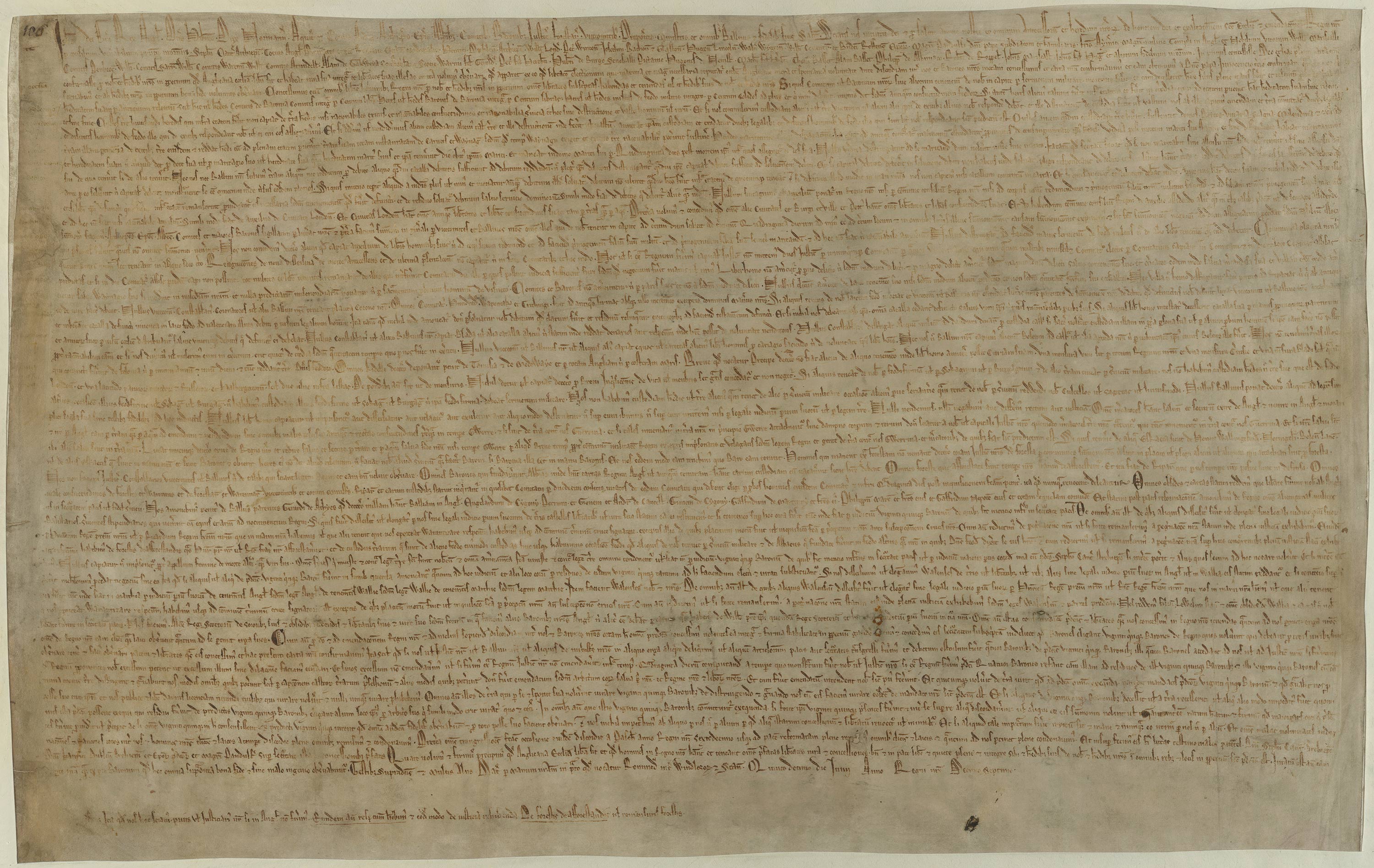
Copy of the Magna Carta on display at the British Library: Chttp://www.bl.uk/collection-items/magna-carta-1215

Copy of the Magna Carta on display at the British Library: Chttp://www.bl.uk/collection-items/magna-carta-1215

The Magna Carta, the “great charter”, was a peace treaty agreement made when  King John was forced to give into a large rebellion led by barons. They were in revolt because of heavy taxation that came as a result of unsuccessful foreign policies.

According to History.com on June 15, 1215, “John met the barons at Runnymede on the Thames and set his seal to the Articles of the Barons, which after minor revision was formally issued as the Magna Carta.” Months later, King John, supported by the Church, nullified the agreement. Despite negation, the document and its provisions survived.

There is a great deal of attention being paid to the Magna Carta as it celebrates its 800th birthday, and The British Library is currently displaying two original copies of the Magna Carta. Their website lists a number of interesting facts about the Magna Carta including:

  • the documents are written on sheepskin parchment;
  • One of the British Library’s 1215 Magna Carta manuscripts was damaged in a fire in the 18th century, the other was found in a London tailor’s shop in the 17th century; 
  • Magna Carta was annulled by the Pope just 10 weeks after it had been issued, being described as “shameful, demeaning, illegal and unjust” and declared “null and void of all validity for ever”.

As part of the publicity for this celebration, The British newpaper The Independent featured interviews with Professor Nicholas Vincent of the University of East Anglia and Professor David Carpenter of King’s College London who are making the claim that the Church, not the royal government, was largely responsible for seeing that copies of the charter were circulated.

According to the article, Magna Carta: New Research Sheds Light on the Church’s Role in Publishing World-famous Charter,(6/14/15) a careful comparison of different handwriting led to the discovery of William of Wilton using royal documents still surviving in English and French archives and ecclesiastical documents surviving in English cathedrals and in the National Archives.

They are confident that it was William of Wilton’s pen that copied the document, including the sentence that became the foundation of our judicial system:

“No free man shall be arrested or imprisoned save by the lawful judgment of their equals or by the law of the land. To no one will we sell, to no one will we deny or delay right or justice.”

There were many other scribes who also copied the manuscript in 1215, but is the copy that contains the DNA of William of Wilton that survived. It is his handiwork that is is enshrined in a place of honor in the British Library today.

So what is history?

The definition of history is a continuous, systematic narrative of past events as relating to particular people, country, period, person, etc., usually written as chronological account. 

We do not know much about William of Wilton, but we can share this story of the Magna Carta with our students to show them how one man’s story makes history real. Here is the story of a man who reproduced documents for a living. He is responsible for the copy of a document that is the foundation of our legal system.

His story is a part of our history as well.

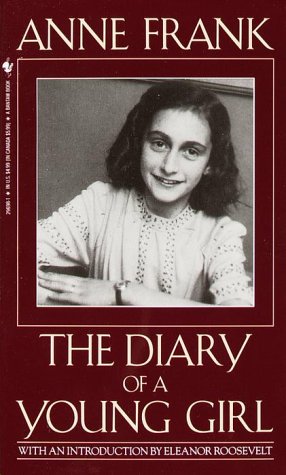
 Anne Frank: The Diary of  Young Girl transcends the labels of genre. anne Frank book

Yes, as the title suggests, it is a diary, but it is also a memoir, a narrative, an argument, an expository journal, an informational text, and much more.

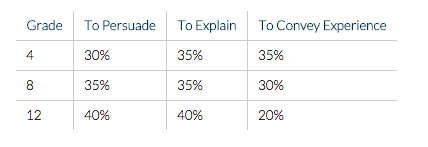
Yet, these genres listed are treated as separate and distinct in the reading and writing standards of the Common Core (CCSS). The standards emphasize the differences between the literary and informational genres. The standards also prescribe what percentages much students should read (by grade 12 30% literary texts/ 70% informational texts), what genres of writing they should practice (narrative, informative/explanatory, argumentative) and the percentages students should expect to communicate  in these genres by grade level.

Distribution of Communicative Purposes by Grade supported by the Common Core

Distribution of Communicative Purposes by Grade supported by the Common Core

In the real world, however, the differences between genres is not as clear and distinct as neatly outlined in the standards. The real world of Nazi occupied Holland was the setting that produced the defiant Diary of Anne Frank.

On June 12, 1942,  Anne Frank received a red and white check autograph book as a birthday gift. This small volume was soon filled by Anne as a diary, the first of three separate volumes, as she her family and friends hid in the secret annex.

A diary is a daily record, usually private, especially of the writer’s own experiences, observations, feelings, attitudes.

Anne’s narrative in these diaries provides a sequence of events and experiences during the two years she spent hiding with others behind the bookcase in the attic where her father had been employed.

A narrative is a story or account of events, experiences, or the like, whether true or fictitious.

In June of 1947 Anne’s father Otto Frank published The Diary of Anne Frank, and it has become one of the world’s best-known memoirs of the Holocaust.

A memoir is a written account in which an individual describes  his or her experiences.

In one entry Anne explains she is aware of what was being done with Jews throughout Europe and those who resisted the Nazis. She refers to radio reports from England, official statements, and announcements in the local papers. There are expository style entries throughout the diary that help the reader understand how much she and others knew about the Holocaust:

“Our many Jewish friends and acquaintances are being taken away in droves. The Gestapo is treating them very roughly and transporting them in cattle cars to Westerbork, the big camp in Drenthe to which they’re sending all the Jews….If it’s that bad in Holland, what must it be like in those faraway and uncivilized places where the Germans are sending them? We assume that most of them are being murdered. The English radio says they’re being gassed.” October 9, 1942

“All college students are being asked to sign an official statement to the effect that they ‘sympathize with the Germans and approve of the New Order.” Eighty percent have decided to obey the dictates of their conscience, but the penalty will be severe. Any student refusing to sign will be sent to a German labor camp.”- May 18, 1943

Expository writing’s purpose is to explain, inform, or even describe.

Finally, there are excerpts taken from the diary where Anne makes a persuasive argument for the goodness of people, even in the most awful of circumstances:

“Human greatness does not lie in wealth or power, but in character and goodness. People are just people, and all people have faults and shortcomings, but all of us are born with a basic goodness.  If we were to start by adding to that goodness instead of stifling it, by giving poor people the feeling that they too are human beings, we wouldn’t necessarily have to give money or material things, since not everyone has them to give.” March 26, 1944

A persuasive argument is a writer’s attempt to convince readers of the validity of a particular opinion on a controversial issue.

Anne’s opinion about the goodness of people during the horrors of the Holocaust is a remarkable argument.

The Diary of Anne Frank gave rise to other genres. Anne’s diaries served as the source material for a play produced in 1955 and then as a film in 1959.

The genre of The Diary of Anne Frank, however, should not be the focus, or the reason for its selection into a curriculum or unit of study. Instead, it is the quality of the writing from a young girl that makes the diary a significant contribution to the literature of the 20th Century.Screenshot 2015-06-11 18.50.33

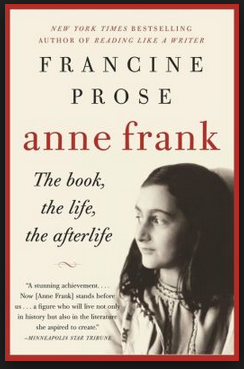
Novelist and former president of the PEN American Center, Francine Prose revisited the diary and was “struck by how beautiful and brilliant it is.” Prose’s research on Anne Frank as a writer culminated with her own retelling, Anne Frank: The Book, the Life, the Afterlife, in which she makes a strong case for the literary quality of Anne’s writing:

“And the more I thought about it, the more I realized how rarely people have really recognized what a conscious, incredible work of literature it is.”

In an interview on the PBS website, Prose was asked, “Do you think there is something about Anne Frank’s voice that continues to resonate with young people today?” Her response,

“I do. Because the diary was written by a kid, it is almost uniquely suited to be read by a kid. Salinger and Mark Twain certainly got certain things right about being a kid; but they weren’t kids when they wrote their books. The diary works on so many different levels.”

When selections from The Diary of Anne Frank were first published in the “Het Parool” on April 3, 1946, the historian Jan Romein also recognized how Anne’s young literary voice rose above the inhumanity that caused in her death at 15 years in the Bergen-Belsen concentration camp. In his review, he writes:

“… this apparently inconsequential diary by a child… stammered out in a child’s voice, embodies all the hideousness of fascism, more so than all the evidence at Nuremberg put together.”

Romein’s review elevates the “apparently inconsequential diary” as testimony in making a legal case against the Nazi regime. It is that power in Anne’s voice that makes her diary a powerful text to offer students, whether it fits the percentages in a CCSS aligned unit of study for an informational text or not.

Her entry on July 15, 1944, written 20 days before she and her family are betrayed to the Nazis reveals yet another genre:

 “I see the world being slowly transformed into a wilderness, I hear the approaching thunder that, one day, will destroy us too, I feel the suffering of millions. And yet, when I look up at the sky, I somehow feel that everything will change for the better, that this cruelty too shall end, that peace and tranquility will return once more.”

For there is poetry in that entry as well.

Oliver Wendell Holmes Jr, a Civil War veteran and a future Supreme Court Justice, delivered a Memorial Day Speech on May 30, 1884, at Keene, New Hampshire, as a tribute to fallen soldiers from the War Between the States. Educators can take an opportunity to use this speech, a primary source document, with their students to study both the historical events that Holmes references as well as his rhetorical style.

First page of Holmes's speech published in book format

First page of Holmes’s speech published in book format

In the first part of the speech, Holmes lays out his belief that twenty years after the Civil War, reunification of the States was possible because of the respect each side had for the other’s convictions:

We believed that it was most desirable that the North should win; we believed in the principle that the Union is indissoluable; we, or many of us at least, also believed that the conflict was inevitable, and that slavery had lasted long enough. But we equally believed that those who stood against us held just as sacred conviction that were the opposite of ours, and we respected them as every men with a heart must respect those who give all for their belief.

Knowing that many in the audience where from the John Sedgwick Post No. 4, Grand Army of the Republic and they had also served in the war, Holmes connected his battlefield memories to theirs, “But you all have known such; you, too, remember!

Holmes poetically recalled his fallen comrades who were killed on the battlefield: a 19-year-old 2nd lieutenant, a fair-haired lad, a surgeon, a captain:

I see them now, more than I can number, as once I saw them on this earth. They are the same bright figures, or their counterparts, that come also before your eyes; and when I speak of those who were my brothers, the same words describe yours.

Holmes then paid tribute to those women who suffered the loss of their husbands, fathers, and brothers; those “…whose sex forbade them to offer their lives, but who gave instead their happiness.” His rhetorical question about the women left behind because of the consequences of war is timeless:

Which of us has not been lifted above himself by the sight of one of those lovely, lonely women, around whom the wand of sorrow has traced its excluding circle–set apart, even when surrounded by loving friends who would fain bring back joy to their lives?

In concluding the speech, Holmes recalls the passion of those young men who entered the Civil War when their “hearts were touched with fire” only to learn that life is “a profound and passionate thing.”

For Social Studies teachers, the speech references different locations where battles took place: Petersburg, Antietam, Port Hudson, and the White Oak Swamp. Holmes also mentions the men killed at those battles: Col. Paul Revere, Jr.; Lt. James. J. Lowell; William L. Putnam; and the suicidal charge of the 20th Massachusetts Regiment. Each location, each name provides students an opportunity for research.

For English Language Arts teachers, the speech is filled with rhetorical devices that students can identify, and then evaluate each devices’s effectiveness in supporting Holmes’s message:

  • Comrades, some of the associations of this day are not only triumphant, but joyful. (direct address)
  • Such hearts–ah me, how many!–were stilled twenty years ago. (caesura-any interruption or break.)
  • Not all of those with whom we once stood shoulder to shoulder–not all of those whom we once loved and revered–are gone.(Anaphora – repeats a word or phrase in successive phrases)
  • Who does not remember the leader of the assault of the mine at Petersburg? (rhetorical question)

In the final lines of the speech, Holmes leans heavily on a literary conceit (elaborate metaphor) of life as music:

Our dead brothers still live for us, and bid us think of life, not death–of life to which in their youth they lent the passion and joy of the spring. As I listen , the great chorus of life and joy begins again, and amid the awful orchestra of seen and unseen powers and destinies of good and evil our trumpets sound once more a note of daring, hope, and will.

Of the 3600 words in Holmes’s speech, the most frequently used words are man, life, and day. By repeating these words, his tribute on Memorial Day in 1884 calls attention to the sacrifices of fallen soldiers in his century, and in ours.


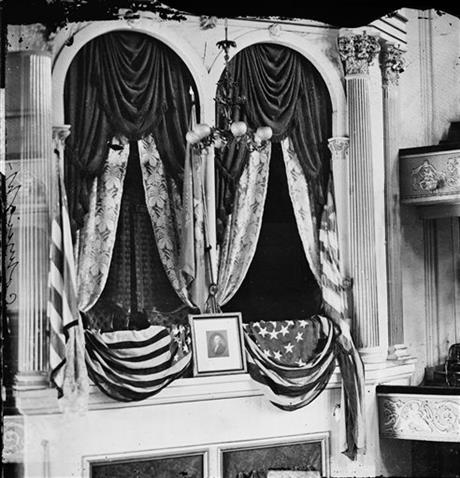
This April 1865 photo provided by the Library of Congress shows President Abraham Lincoln\'s box at Ford\'s Theater, the site of his assassination. Under the headline "Great National Calamity!" the AP reported Lincoln’s assassination, on April 15, 1865. (AP Photo/Library of Congress)

This April 1865 photo provided by the Library of Congress shows President Abraham Lincoln\’s box at Ford\’s Theater, the site of his assassination. Under the headline “Great National Calamity!” the AP reported Lincoln’s assassination, on April 15, 1865. (AP Photo/Library of Congress)

News stories are generally written in what is commonly known as the inverted pyramid style, in which the opening paragraph features the “5 Ws” of journalism: Who, What, Where, When, Why, and How. The reason for this style is so that the reader gets the most important information up front. Given the amount of time readers have today to read the amount of news generated in a 24 hour news cycle, the inverted pyramid makes sense.

In contrast, 150 years ago a dispatch by the Associated Press took a storytelling approach  when President Abraham Lincoln’s assassination at the hands of John Wilkes Booth was relayed by AP correspondent Lawrence Gobright. Under the headline”Great National Calamity!” he chose to deliver gently the monumental news of Lincoln’s death in paragraph 9:

The surgeons exhausted every effort of medical skill, but all hope was gone.

The Common Core State Standards in Literacy promotes primary source documents, such as this news release, in English Language Arts and Social Studies. Documents like this provide students an opportunity to consider the voice or point-of-view of a writer within a historical context.

In this 19th Century AP news release, an editor’s note attached described in vivid detail Gobright’s efforts to gain first-hand information in compiling the story of Lincoln’s assassination. In the tumult that followed the assassination, Gobright became more than a witness as he:

scrambled to report from the White House, the streets of the stricken capital, and even from the blood-stained box at Ford’s Theatre, where, in his memoir he reports he was handed the assassin’s gun and turned it over to authorities.

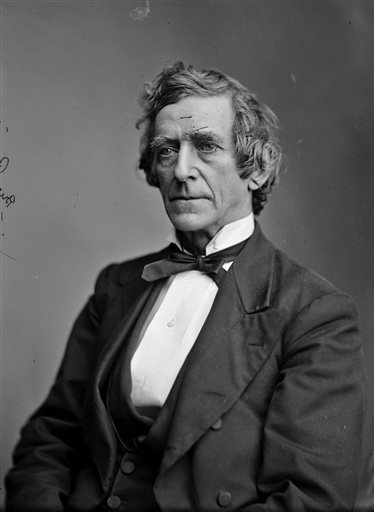
This circa 1865-1880 photograph provided by the Library of Congress' Brady-Handy Collection shows Lawrence A. Gobright, the Associated Press' first Washington correspondent. A native of Hanover, Pa., Gobright covered both inaugurations of Abraham Lincoln, the Civil War and Lincoln's assassination during a career spanning more than a third of a century in Washington. Under the headline "Great National Calamity!" the AP reported President Abraham Lincoln’s assassination, on April 15, 1865. (AP Photo/Library of Congress)

This circa 1865-1880 photograph provided by the Library of Congress’ Brady-Handy Collection shows Lawrence A. Gobright, the Associated Press’ first Washington correspondent.. Under the headline “Great National Calamity!” the AP reported President Abraham Lincoln’s assassination, on April 15, 1865. (AP Photo/Library of Congress)

Gobright’s opening line for the news story identified the setting as Ford’s Theatre; he then added information of considerable interest to the Union Army, that:

It was announced in the papers that Gen. Grant would also be present, but that gentleman took the late train of cars for New Jersey.

After setting up who was or was not in attendance,  Gobright detailed the sequence of events in paragraph 3:

During the third act and while there was a temporary pause for one of the actors to enter, a sharp report of a pistol was heard, which merely attracted attention, but suggested nothing serious until a man rushed to the front of the President’s box, waving a long dagger in his right hand, exclaiming, ‘Sic semper tyrannis,’

Describing the assailant’s escape on horseback, Gobright concluded the reaction of the crowd in the audience in paragraph 4 in an understatement, “The excitement was of the wildest possible description…”

His AP’s edited version online states that the report does not contain details on the second assassination report on Secretary of State William Seward. There is his reference to the other members of Lincoln’s cabinet who, after hearing about the attack on Lincoln, travelled to the deathbed:

They then proceeded to the house where the President was lying, exhibiting, of course, intense anxiety and solicitude.

As part of a 150 year memorial tribute, the AP offers two websites with Gobright’s report, the first with an edited version of the report and the second, an interactive site with graphics. The readabilty score on Gobright’s release is a grade 10.3, but with some frontloading of vocabulary (solicitude, syncope) this story can be read by students in middle school. There are passages that place the student in the moment such as:

  • There was a rush towards the President’s box, when cries were heard — ‘Stand back and give him air!’ ‘Has anyone stimulants?’
  • On an examination of the private box, blood was discovered on the back of the cushioned rocking chair on which the President had been sitting; also on the partition and on the floor.

The NYTimes reporting of the assassination, having the advantage of several hours start, did not bury the lede, or begin with details of secondary importance, offering the critical information through a series of headlines beginning with the kicker “An Awful Event”:

An Awful Event
The Deed Done at Ford’s Theatre Last Night.
THE ACT OF A DESPERATE REBEL
The President Still Alive at Last Accounts.
No Hopes Entertained of His Recovery.
Attempted Assassination of Secretary Seward.
DETAILS OF THE DREADFUL TRAGEDY.

Their six column spread allowed space for the six drop heads, or smaller secondary headlines, above that were stacked to provide an outline of the events. The article that follows begins with then Secretary of War Edwin Stanton’s message to Major General Dix, April 15, 1865 at 1:30 AM:

This evening about 9:30 PM, at Ford’s Theatre, the President while sitting in his private box, with Mrs. Lincoln, Mrs. Harris, and Major Rathburn, was shot by an assassin who suddenly entered the box and approached behind the President.

Stanton’s 324 word report has a readability grade 7.2, and includes also details about the other assassination attempt on Seward’s life:

About the same hour an assassin, whether the same or not, entered Mr. SEWARD’s apartments, and under the pretence of having a prescription, was shown to the Secretary’s sick chamber. The assassin immediately rushed to the bed, and inflicted two or three stabs on the throat and two on the face.

A second dispatch features Gobright’s reporting and appears below Stanton’s message in the second column. Following these accounts, a third dispatch  by an unnamed reporter is dated Friday, April 14, 11:15 P.M. and like Gobright’s account begins with a storybook-type lead:

A stroke from Heaven laying the whole of the city in instant ruins could not have startled us as did the word that broke from Ford’s Theatre a half hour ago that the President had been shot. It flew everywhere in five minutes, and set five thousand people in swift and excited motion on the instant.

These first-person accounts of Gobright, Stanton, and others covering Lincoln’s assassination will allow students to contrast what they recognize as the reporting styles of today with an example of the storytelling reporting style 150 years ago. Students can analyze both styles for conveying information, and then comment on impact each style may have on an audience.

More important is the opportunity to ditch the dry facts from a textbook, as these newspaper releases allow students to discover that at the heart of stories about Lincoln’s assassination, the reporters were really storytellers, and their hearts were breaking.

During a pop-in visit with the 8th grade social studies teachers last week, the discussion turned to the growing number of interruptions to the school calendar because of the snow cancellations and delays we are experiencing here in Connecticut this winter. The teachers were grumbling, frustrated that they were not able to cover the content in the curriculum units.

“There are some advantages to ice and snow this winter,” I suggested.
They looked at me skeptically.
“Our students are feeling the same conditions that the Continental Army felt that winter at Valley Forge,” they paused.
I continued, “I can’t imagine how teachers in San Diego get students to understand what it was like to be a soldier in that winter in 1778.”

Of course, imagine is the key word here. Students taking classes in sunny 75 degree weather would have to imagine the conditions penned by George Washington to then New York Governor George Clinton from his headquarters in a chilly farmhouse at Valley Forge. Our first Commander-in-Chief’s desperation to keep his troops fed and clothed in frigid conditions is clearly evident in this letter, written while the well-stocked British troops camped comfortably nearby in Philadelphia. During that encampment at Valley Forge beginning on December 19, 1777, nearly 2,500 American soldiers, a quarter of the Continental Army, succumbed to disease and exposure by the end of February 1778. A modified version of Washington’s letter for students (Created through the TAH Making History Grant)  appears below:

To Governor George Clinton

Head Quarters, Valley Forge, February 16, 1778

Dear Sir:

It is with great reluctance, I trouble you … For some days…, there has been…a famine in camp. A part of the army has been a week, without any kind of flesh, and the rest for three or four days. Naked and starving as they are, we cannot enough admire the incomparable patience and fidelity of the soldiery, that they have not been [led]…by their sufferings, to a general mutiny…

…I am, on my part, putting every engine to work, that I can possibly think of, to prevent…fatal consequences…. I am calling upon all those, whose stations and influence enable them to contribute their aid upon so important an occasion; … I expect every thing within the compass of your power, and that the abilities and resources of the state over which you preside, will admit….

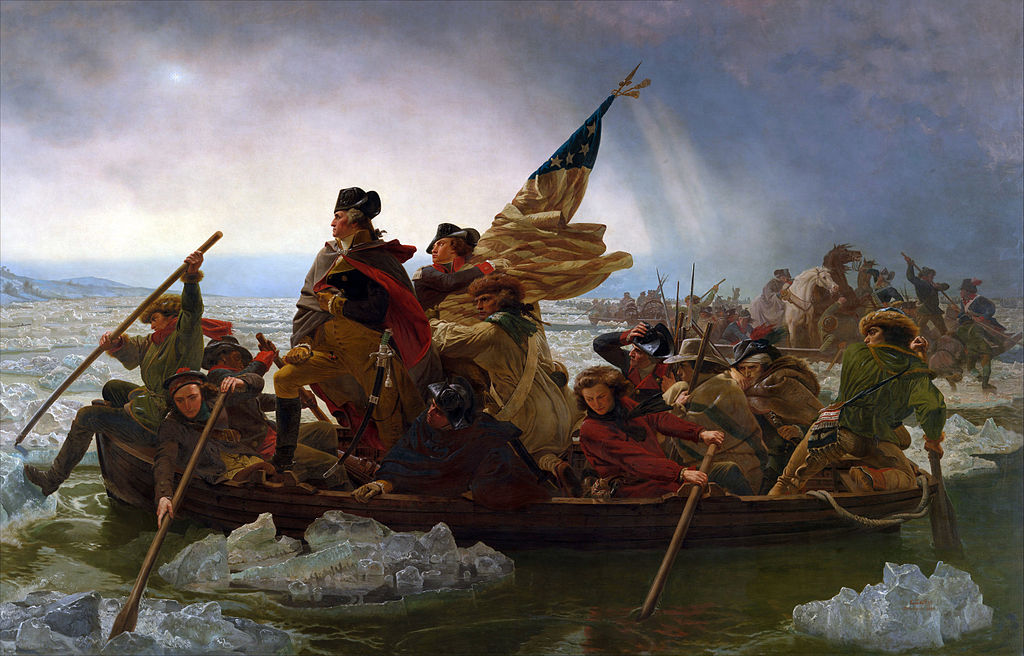
Valley Forge was not Washington’s first test of endurance in harsh winter conditions. Two years previous to this encampment, Washington had successfully crossed the Delaware River in a surprise attack against the Hessian forces in Trenton, New Jersey. Taking advantage of the Hessian’s late night holiday celebration, Washington crossed the icy waters on December 25, and attacked on the following morning.

Washington’s trip across the icy waters was immortalized in the painting Washington Crossing the Delaware by Emanuel Leutze, (Metropolitan Museum of Art-NYC, 1851).

Washington_Crossing_the_Delaware_by_Emanuel_Leutze,_MMA-NYC,_1851

Washington Crossing the Delaware is also the name and subject of a sonnet by David Shulman (1936).  This sonnet is entirely composed of anagrams, or verses of word play, where the letters of a word or phrase are used (once) to produce a new words or in Shulman’s case, verses:

A hard, howling, tossing water scene.
Strong tide was washing hero clean.
“How cold!” Weather stings as in anger.
O Silent night shows war ace danger!

The cold waters swashing on in rage.
Redcoats warn slow his hint engage.
When star general’s action wish’d “Go!”
He saw his ragged continentals row.

Ah, he stands – sailor crew went going.
And so this general watches rowing.
He hastens – winter again grows cold.
A wet crew gain Hessian stronghold.

George can’t lose war with’s hands in;
He’s astern – so go alight, crew, and win!

The nation’s tribute to George Washington, combined his birthday (2/22) with Lincoln’s birthday (2/12) to make President’s Day, a National Holiday celebrated from the frigid shores of the Delaware River, across those same fields of Valley Forge, and all the way to the warm sunny beaches of the San Diego coastline.

The combination of Washington’s letter to George Clinton, the famous painting by Emanuel Leutze, and the sonnet by David Shulman can help students everywhere in the United States to imagine the severe weather conditions of these most famous exploits of Washington, but the students here in the Mid-Atlantic and in New England have the historical advantage to experience that same weather first-hand every year.

Here in Connecticut, in the winter of 2015, our students’ empathy lies with George.

Here is an educational policy riddle: How much background knowledge does a student need to read a historical text?

According to New York Engage website: None.

The Common Core State Standards (CCSS) are being implemented state by state, and there is an emphasis from teaching students background knowledge to teaching students skills, specifically the skill of close reading.

The pedegogy is explained by The Partnership for Assessment of Readiness for College and Careers (PARCC):

Close, analytic reading stresses engaging with a text of sufficient complexity directly and examining meaning thoroughly and methodically, encouraging students to read and reread deliberately. Directing student attention on the text itself empowers students to understand the central ideas and key supporting details. It also enables students to reflect on the meanings of individual words and sentences; the order in which sentences unfold; and the development of ideas over the course of the text, which ultimately leads students to arrive at an understanding of the text as a whole. (PARCC, 2011)

There are many lessons that strongly advocate the use of close reading in teaching historical texts on the EngageNY.com website, including a set of exemplar lessons for Lincoln’s Gettysburg Address promoted by CCSS contributor and now College Board President, David Coleman. The lesson’s introduction states:

The idea here is to plunge students into an independent encounter with this short text. Refrain from giving background context or substantial instructional guidance at the outset. It may make sense to notify students that the short text is thought to be difficult and they are not expected to understand it fully on a first reading–that they can expect to struggle. Some students may be frustrated, but all students need practice in doing their best to stay with something they do not initially understand. This close reading approach forces students to rely exclusively on the text instead of privileging background knowledge, and levels the playing field for all students as they seek to comprehend Lincoln’s address.

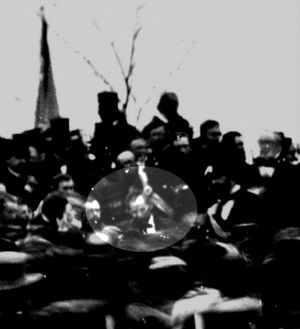
Photo of Lincoln delivering Gettysburg Address- (www.wikipedia.org)

Photo of Lincoln delivering
Gettysburg Address- (www.wikipedia.org)

The lesson plan is organized in three sections. In the first, students are handed a copy of Lincoln’s Gettysburg Address and perform several “cold” readings, to themselves and then with the class.

Lesson Plan SECTION 1 What’s at stake: a nation as a place and as an idea

Students silently read, then the teacher reads aloud the text of the Gettysburg Address while students follow along.

  • Students translate into their own words the first and second paragraph. 
  • Students answer guiding questions regarding the first two paragraphs

Please note, there is no mention of any historical context for the speech. Students will come to this 273-word speech without the background knowledge that the Battle of Gettysburg was fought from July 1 to July 3, 1863, and this battle is considered the most important engagement of the American Civil War. They will not know that the battle resulted in “Union casualties of 23,000, while the Confederates had lost some 28,000 men–more than a third of Lee’s army” (History.com). They will not know how the Army of Northern Virginia achieved an apex into Union territory with “Pickett’s Charge,” a failed attempt by General George Pickett  to break through the Union line in South Central Pennsylvania, and that the charge resulted in the death of thousands of rebel soldiers. They will not know how the newly appointed Major General George Gordon Meade of the Army of the Potomac met the challenges of General Robert E. Lee by ordering responses to skirmishes on Little Round Top, Culp’s Hill, and in the Devil’s Den. They will not know that Meade would then be replaced by General Ulysses S. Grant in part because Meade did not pursue Lee’s troops in their retreat to Virginia.

Instead of referencing any of this historical background, the guding questions in the lesson’s outline imagine the students as blank slates and mention another historical event:

A. When was “four score and seven years ago”? B. What important thing happened in 1776?

The guiding responses for teachers seem to begrudge an acknowledgement that keeping students bound to the four corners of a text is impossible, and that, yes, a little prior knowledge of history is helpful when reading a historical text:

This question, of course, goes beyond the text to explore students’ prior knowledge and associations. Students may or may not know that the Declaration of Independence was issued in 1776, but they will likely know it is a very important date – one that they themselves have heard before. Something very important happened on that date.  It’s OK to mention the Declaration, but the next step is to discover what students can infer about 1776 from Lincoln’s own words now in front of them.

In addition, there are admonishments in Appendix A of the lesson not to ask questions such as, “Why did the North fight the civil war?”

Answering these sorts of questions require students to go outside the text, and indeed in this particular instance asking them these questions actually undermine what Lincoln is trying to say. Lincoln nowhere in the Gettysburg Address distinguishes between the North and South (or northern versus southern soldiers for that matter). Answering such questions take the student away from the actual point Lincoln is making in the text of the speech regarding equality and self-government.

The lesson plan continues:

Lesson Plan SECTION 2  From funeral to new birth

  • Students are re-acquainted with the first two paragraphs of the speech.
  • Students translate the third and final paragraph into their own words.
  • Students answer guiding questions regarding the third paragraph of the Gettysburg Address.

Please note this does not provide the context of the speech that was given that crisp morning of November 19, 1863, at the dedication of the National Cemetery on a damp battlefield that only months before had been dampened red with the blood of tens of thousands of soldiers from either side. The students would be unaware that Lincoln had taken the train from Washington the day before and was feeling slightly feverish on the day of the speech. There is some speculation that he may have been suffering from the early stages of smallpox when he delivered the speech reading from a single piece of paper in a high clear voice. The students would not know that Lincoln’s scheduled time at the podium followed a two hour (memorized) speech by Edward Everett, who later wrote to Lincoln stating, “I should be glad if I could flatter myself that I came as near the central idea of the occasion in two hours as you did in two minutes.” The students would not know that many of the 15,000 crowd members did not hear Lincoln’s two minute speech; the 10 sentences were over before many audience members realized Lincoln had been speaking. The students would not know that this speech marked Lincoln’s first public statement about principles of equality, and they would not know that he considered the speech to be a failure.

Lesson Plan SECTION 3  Dedication as national identity and personal devotion

  • Students trace the accumulated meaning of the word “dedicate” through the text
  • Students write a brief essay on the structure of Lincoln’s argument

The lesson provides links to the five handwritten copies of the text, in the “Additional ELA Task #1: Comparison of the drafts of the speech” so that students can see drafts of the speech and the inclusion of “under God” in the latter three versions. There is also an additional Social Studies task that incorporates the position of respected historian Gary Wills from his book Lincoln at Gettysburg: The Worlds that Remade America. This activity suggests students use excerpts from Wills’s book and an editorial from the Chicago Times (November 23, 1863) to debate “Lincoln’s reading of the Declaration of Independence into the Constitution”. One excerpt from Wills’s book includes the statement,”The stakes of the three days’ butchery are made intellectual, with abstract truths being vindicated.” Finally, here is information about the battle itself; the battle lasted three days and soldiers died.

The enterprise of reading the Gettysburg Address without context defeats PARRC’s stated objective of having the students “arrive at an understanding of the text as a whole”. The irony is that in forwarding their own interpretation of the speech, David Coleman and the lesson plan developers have missed Lincoln’s purpose entirely; Lincoln directs the audience to forget the words of the speech, but never to forget the sacrifices made by the soldiers during that brutal conflict:

The world will little note, nor long remember what we say here, but it can never forget what they did here.

Lincoln wrote and delivered the Gettysburg Address to remind his audience “that these dead shall not have died in vain”. Analyzing the language of the address isolated from the Civil War context that created the tone and message is a hollow academic exercise. Instead, students must be taught the historical context so that they fully understand Lincoln’s purpose in praising those who, “gave the last full measure of devotion.”

“It is altogether fitting and proper that we should do this.”

Continue Reading…

This post completes a trilogy of reflections on the Connecticut Academic Performance Test (CAPT) which will be terminated once the new Smarter Balance Assessments tied to the Common Core State Standards (CCSS) are implemented. There will be at least one more year of the same CAPT assessments, specifically the Interdisciplinary Writing Prompt (IW) where 10th grade students write a persusive essay in response to news articles. While the horribly misnamed Response to Literature (RTL) prompt confuses students as to how to truthfully evaluate an story and drives students into “making stories up” in order to respond to a question, the IW shallowly addresses persuasive writing with prompts that have little academic value.

According to the CAPT Handbook (3rd Generation) on the CT State Department of Eduction’s website, the IW uses authentic nonfiction texts that have been:

“… published and are informational and persuasive, 700-1,000 words each in length, and at a 10th-grade reading level.  The texts represent varied content areas (e.g., newspaper, magazine, and online articles, journals, speeches, reports, summaries, interviews, memos, letters, reviews, government documents, workplace and consumer materials, and editorials).  The texts support both the pro and con side of the introduced issue.  Every effort is made to ensure the nonfiction texts are contemporary, multicultural, engaging, appropriate for statewide implementation, and void of any stereotyping or bias.  Each text may include corresponding maps, charts, graphs, and tables.”

Rather than teach this assessment in English, interdisciplinary writing is taught in social studies because the subject of social studies is already interdisciplinary. The big tent of social studies includes elements of economics, biography, law, statistics, theology, philosophy, geography, sociology, psychology, anthropology, political science and, of course, history. Generally, 9th and 10 grade students study the Ancient World through Modern European World (through WWII) in social studies. Some schools may offer civics in grade 10.

Social studies teachers always struggle to capture the breadth of history, usually Western Civilization, in two years. However, for 15 months before the CAPT, social studies teachers must also prepare students to write for the IW test. But does the IW reflect any of the content rich material in social studies class? No, the IW does not. Instead the IW prompt is developed on some “student centered” contemporary issue. For example, past prompts have included:

  • Should students be able to purchase chocolate milk in school?
  • Should utility companies construct wind farms in locations where windmills may impact scenery or wildlife?
  • Should ATVs be allowed in Yellowstone Park?
  • Should the school day start later?
  • Should an athlete who commits a crime be allowed to participate on a sports team?
  • Should there be random drug testing of high school students?

On the English section of the test, there are responses dealing with theme, character and plot. On the science section, the life, physical and earth sciences are woven together in a scientific inquiry. On the math section, numeracy is tested in problem-solving. In contrast to these disciplines, the social studies section, the IW, has little or nothing to do with the subject content. Students only need to write persuasively on ANY topic:

For each test, a student must respond to one task, composed of a contemporary issue with two sources representing pro/con perspectives on the issue.  The task requires a student to take a position on the issue, either pro or con.  A student must support his or her position with information from both sources.  A student, for example, may be asked to draft a letter to his or her congressperson, prepare an editorial for a newspaper, or attempt to persuade a particular audience to adopt a particular position.  The task assesses a student’s ability to respond to five assessed dimensions in relationship to the nonfiction text: (1) take a clear position on the issue, (2) support the position with accurate and relevant information from the source materials, (3) use information from all of the source materials, (4) organize ideas logically and effectively, and (5) express ideas in one’s own words with clarity and fluency.

The “authentic” portions of this test are the news articles, but the released materials illustrate that these news articles are never completely one-sided; if they are written well, they already include a counter-position.  Therefore, students are regurgitating already highly filtered arguments. Secondly, the student responses never find their way into the hands of the legislators or newspaper editors, so the responses are not authentic in their delivery. Finally, because these prompts have little to do with social studies, valuable time that could be used to improve student content knowledge of history is being lost.  Some teachers use historical content to practice writing skills, but there is always instructional time used to practice with released exam materials.

Why are students asked to argue about the length of a school day when, if presented with enough information, they could argue a position that reflects what they are learning in social studies? If they are provided the same kinds of newspaper, magazine, and online articles, journals, speeches, reports, summaries, interviews, memos, letters, reviews, government documents, workplace and consumer materials, and editorials, could students write persuasive essays with social studies content that is measurable? Most certainly. Students could argue whether they would support a government like Athens or a government like Sparta. Students could be provided brief biographies and statements of belief for different philosophers to argue who they would prefer as a teacher, DesCartes or Hegel. Students could write persuasively about which amendment of the United States Constitution they believe needs to be revisited, Amendment 10 (State’s Rights) or Amendment 27 (Limiting Changes to Congressional Pay).

How unfortunate that such forgettable issues as chocolate milk or ATVs are considered worthy of determining a student’s ability to write persuasively. How inauthentic to encourage students to write to a legislator or editor and then do nothing with the students’ opinions. How depressing to know that the time and opportunity to teach and to measure a student’s understanding of the rich content of social studies is lost every year with IW test preparation.

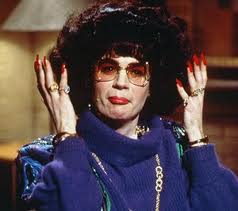
coffeetalkMaybe the writers of the CAPT IW prompt should have taken a lesson from the writers of Saturday Night Live with the Coffee Talk with Michael Myers. In these sketches, Myers played Linda Richmond, host of the call-in talk show “Coffee Talk”. When s(he) would become too emotional (or feclempt or pheklempt ) to talk, s(he) would “give a topic” to talk “amoungst yourselves”.  Holding back tears, waving red nails in front of his face furiously, Myers would gasp out one of the following:

“The Holy Roman Empire was neither holy, Roman, nor an empire….Discuss…”

“Franklin Delano Roosevelt’s New Deal was neither new nor a deal…. Discuss…”

“The radical reconstruction of the South was neither radical nor a reconstruction…. Discuss…”

“The internal combustion engine was neither internal nor a combustion engine…. Discuss…”

If a comedy show can come up with these academic topics for laughs, why can’t students answer them for real? At least they would understand what made the sketches funny, and that understanding would be authentic.