Archives For November 30, 1999

I believe the author Stephen King would hate the language of the Common Core State Standards for one reason: unnecessary adverbs. His book On Writing has a section devoted to explaining why The adverb is not your friend.

Adverbs … are words that modify verbs, adjectives, or other adverbs. They’re the ones that usually end in -ly. Adverbs, like the passive voice, seem to have been created with the timid writer in mind. … With adverbs, the writer usually tells us he or she is afraid he/she isn’t expressing himself/herself clearly, that he or she is not getting the point or the picture across.

I have written about King and adverbs before. As I am implementing the standards in my high school English curriculums, I find myself agreeing with him.  Take, for example, the Common Core Anchor Reading Standard 1. The standard states:

Read closely to determine what the text says explicitly and to make logical inferences from it; cite specific textual evidence when writing or speaking to support conclusions drawn from the text. CCSS.ELA-LITERACY.CCRA.R.1

The use of adverbs in this standard has led to more confusion, not less. The expression “read closely” was recoined as “close reading,” and that has resulted in parodies of teachers holding books up to their faces, mocking the standard. Why the writers of the Common Core felt the need to modify the action verb “read” at all is perplexing. Students must read to determine what a text says. That is all. The admonishment to “read closely” to determine what the “text says explicitly” infers the author is either trying to slip an idea past a reader or the author has been ineffective in communicating the idea. I am not convinced any author would appreciate this standard.

Moreover, the Common Core Anchor Writing Standards have the same problem, for example,

Write informative/explanatory texts to examine and convey complex ideas and information clearly and accurately through the effective selection, organization, and analysis of content. CCSS.ELA-LITERACY.CCRA.W.2

I believe that every teacher requires students to convey “complex ideas and information clearly and accurately,” yet the language of this standard infers that students would be allowed to write distorted or inaccurate responses. The standard should read, “Write informative/explanatory texts to examine and convey complex ideas and information through the effective selection, organization, and analysis of content.” The adverbs are redundant, as King demonstrates in On Writing: (bolded words his choice)

Consider the sentence He closed the door firmly. It’s by no means a terrible sentence (at least it’s got an active verb going for it), but ask yourself if firmly really has to be there. You can argue that it expresses a degree of difference between He closed the door and He slammed the door, and you’ll get no argument from me … but what about context? What about all the enlightening (not to say emotionally moving) prose which came before He closed the door firmly? Shouldn’t this tell us how he closed the door? And if the foregoing prose doestell us, isn’t firmly an extra word? Isn’t it redundant?

The same editing should be applied to the Speaking and Listening Anchor Standards:

Prepare for and participate effectively in a range of conversations and collaborations with diverse partners, building on others’ ideas and expressing their own clearly and persuasively. CCSS.ELA-LITERACY.CCRA.SL.1

In this standard, the subjective nature of the adverb “effectively” creates the same confusion as reading “closely.” This standard could be made measurable if the emphasis was on the infinitive “to persuade” rather than on the timid adverbs “effectively” and “persuasively.”  How does one measure these terms, unless by degrees? An argument is either effective or not. Readers are persuaded or not. A standard is unequivocal. The present wording could lead to much equivocating if a reader has to determine the degree of “effectively” or “persuasively.” Try this rewrite: Prepare for and participate in a range of conversations and collaborations with diverse partners, building on others’ ideas in order to persuade.”

In addition, the Language (or grammar standards) themselves contain a distracting adverbial phrase:

Apply knowledge of language to understand how language functions in different contexts, to make effective choices for meaning or style, and to comprehend more fully when reading or listening.CCSS.ELA-LITERACY.CCRA.L.3

The phrase comprehend”more fully” sounds like a phrase from one of my student’s essays. I would equate the construct of “more fully” with “as a whole” or “the fact that” or the ubiquitous word “flows” found in my weaker writers’ responses. These are all phrases that receive a large NO! in red ink from me as I grade or confer. A reader comprehends or a reader does not.

King argues that writers must be deliberate in stemming adverbs in this selection from On Writing:

Someone out there is now accusing me of being tiresome and anal-retentive. I deny it. I believe the road to hell is paved with adverbs, and I will shout it from the rooftops. To put it another way, they’re like dandelions. If you have one on your lawn, it looks pretty and unique. If you fail to root it out, however, you find five the next day . . . fifty the day after that . . . and then, my brothers and sisters, your lawn is totally, completely, and profligately covered with dandelions. By then you see them for the weeds they really are, but by then it’s — GASP!! — too late.

King is proved correct about the propagation of adverbs in the language of the Common Core. Adverbs pop up in the NOTES ON sections that follow the anchor standards. For example:

Notes on Range and Content of Student Reading

Students can only gain this foundation when the curriculum is intentionally and coherently structured to develop rich content knowledge within and across grades. Students also acquire the habits of reading independently and closely, which are essential to their future success.

Notes on Range and Content of Student Speaking and Listening

Digital texts confront students with the potential for continually updated content and dynamically changing combinations of words, graphics, images, hyperlinks, and embedded video and audio.

When a reader removes the bolded words, the pedantic tone disappears. The implications that curriculum is “unintentional” or “unstructured” is removed. The confusion as to what reading “closely” means is removed. Don’t even get me started as to why “dynamically” is there, although I suspect the use is to suggest there may be some form of cool media out there that does not yet exist so the CCSS writers modified the adjective “changing” on combination with “dynamically” to cover future media constructs. The only adverb in this section that needs to be included is “independently,” and that should be an adjective. We all want independent readers, so be clear and say “independent readers.”

Stephen King has had an impact on my writing, and when I come to including an adverb I pause to think if that adverb is necessary. Would that the writers of the Common Core felt the same. The standards are riddled with adverbs. How did I find most of them? I used the “Find” option (command-F on my Mac) and put “LY” in the search box. How did I know that most adverbs end with ly?  Here, for your enjoyment, is my favorite adverb resource, a video from Schoolhouse Rock with the charming song about adverbs that remains emblazoned on my brain:

Consider how the advice from King and the lesson from this video can be used by teachers in stopping the flood of adverbs and in applying the Speaking and Listening standard in a classroom where “Digital texts confront students with the potential for updated content and changing combinations of words”….. NOTE: continually and dynamically not included.


theatre-stage-81d434 copyShakespeare’s sonnets are little one-act plays.
I learned this one year when I was teaching drama to grades 9-12 and I discovered Will and WhimsySixteen Dramatically Illustrated Sonnets of Shakespeare by Alan Haehnel. The short comic/poignant skits in the collection are an excellent way for middle school and high school students to be exposed to the Bard’s 154 poems.
Consequently, when I began the study of sonnets with my Advanced Placement English Literature students, I thought they might benefit from a similar technique. In addition, I considered that this could be an opportunity for them to write a narrative as required by the Common Core State Standards:

CCSS.ELA-LITERACY.W.11-12.3
Write narratives to develop real or imagined experiences or events using effective technique, well-chosen details, and well-structured event sequences.

“Imagine a character in each sonnet is talking to you,” I explained, “you need to synthesize the ideas from the poem, and write that character’s story.”

Then, I handed out copies of Shakespeare’s Sonnet 29:

sonnet 29

When, in disgrace with fortune and men’s eyes,
I all alone beweep my outcast state,
And trouble deaf heaven with my bootless cries,
And look upon myself, and curse my fate,
Wishing me like to one more rich in hope,
Featur’d like him, like him with friends possess’d,
Desiring this man’s art and that man’s scope,
With what I most enjoy contented least;
Yet in these thoughts myself almost despising,
Haply I think on thee, and then my state,
Like to the lark at break of day arising
From sullen earth, sings hymns at heaven’s gate;
For thy sweet love remember’d such wealth brings
That then I scorn to change my state with kings.

On the bottom of the page I restated one simple direction, “Write the narrative.”

The results were unexpected. While my students are good at analyzing poems, I was unaware that a number of them are born storytellers. In their retellings, they captured the spirit, and sometimes the exact language, of the poem. They found ways to expand on the isolation and alienation of the speaker and incorporate the shift in the speaker’s attitude from despair to one of acceptance.

For example, Melissa used a pivotal moment in the lives of high school students…asking someone to go to the prom:

After weeks of preparation and endless nerves the day has come to ask her to come to prom with me!
I wrote her a poem listing all the things I liked about her and read it to her under the starlight sky just at sunset.
I ended the poem with “thy sweet love remember’d such wealth brings.”
My nerves ran through my body and I felt like I was going to pass out.
YES! SHE SAID YES!
I take her off to dinner and we planned for the night of prom. My dreams have come true! I am going to my senior prom with the girl of my dreams!

In contrast, Makayla began her narrative from the point of view of a frighteningly depressed teenager who observes others in a community park. The young girl’s attention is eventually drawn to one elderly couple, and their tenderness towards each other brings about an “epiphany,” a realization:

I inhale a summer thriving breathe and release the darkness out of my body. I turn to walk down the once sullen Earth path now as a gateway to sweet heaven’s gate. I take my phone out of the bag and dial my boyfriend’s number to make things right and explain myself to him. I pass the two elderly couple and smile.
In return I get a friendly, “Beautiful day, isn’t it?” and I respond, “Yes, yes ,it truly is, and I won’t beweep it again.”
As I near the running children, I pulled my bag off my shoulder and slipped it into a nearby trashcan. It’s time to change my state with kings.

Emma’s chose to use the point-of-view of an elderly woman suffering from Alzheimer’s in this poignant tale:

He doesn’t know that me is right underneath all of this forgotten memory. I’m right here, but I don’t know who I am. I bury my face in my wrinkled hands and trouble deaf heaven with my bootless cries. I can’t change. Curse my fate.
When I look up he’s standing over me. “Your appointment is at four.”
I swear I didn’t know. When I searched his face for recognition, I knew that he did not see me. He doesn’t know who I am and neither do I. He doesn’t understand that I can’t control my fate. But I am not my forgotten memory, I am his wife. That much, I know.

Finally, Jen’s story was humorous, told from the perspective of a jilted bride:

I’m sitting alone on altar steps in my once-worn Vera Wang wedding dress that’s as deflated now as I feel. My supposed-to-be husband left me for some California-toned, bottle-blond chick bustier than Dolly Parton. (Curses her and her awesome figure. I swear she was created by Russian scientists.) I all alone beweep my outcast state….

….That son-of-a-bitch should not be in my thoughts right now. Well, maybe he should considering he was a 10 thousand dollar mistake. Dammit I looked good in that dress.
Sullen Earth, why me?

What started out as an educated guess for an assignment on my part has yielded great results. Moreover, my students have written narratives based on  “this man’s art.”

“We loved writing these,” was their collective response.
Of course they did….hard to go wrong with Shakespeare as their mentor.

Continue Reading…

The 86th Saturday Reunion (3/22/14) at Teacher’s College in NYC was decidedly political. Not political as in elections or party affiliation, but political as education is critical to “the public affairs of a country.”

The morning keynote address by Diane Ravitch set the agenda. Ravitch is an education historian and an author who served as Assistant Secretary of Education and Counselor to Secretary of Education Lamar Alexander under President George H.W. Bush.  She was Adjunct Professor of History and Education at Teachers College, Columbia University; this Saturday, she returned to speak at Riverside Cathedral.

She began by recalling another political era, calling the cathedral the “sacred space” where William Sloan Coffin had spoken out against the Vietnam War.  This time Ravitch was speaking out against the war on public education.

Screen Shot 2014-03-23 at 9.48.58 AMShe began by alerting the enormous crowd of teachers about the Network for Public Education. This year-old network was established to, “Give the [us] the courage to fight; our motto is ‘We are are many, they are few, we will prevail’,” she claimed.

Screenshot 2014-03-23 19.04.39“I wrote Reign of Error for you to use as ammunition… but, for heaven’s sakes, don’t buy it,” she insisted, “borrow it from the library, but use it to fight back the efforts to undermine education.”

Ravitch has been organizing a defense that is aimed at exposing the corporate take over of education that is endemic to this country alone. She countered that other nations have “no charters and no vouchers,” adding that “charters and vouchers divide communities” in economic funding. She challenged the treatment of teachers in the USA, insisting that other nations respect teachers and do not let “amateurs become principals and superintendents.” 

She spoke of challenges in providing for the inequities in education, detailing that 25% of children today live in poverty, and she demanded to know how our public schools will survive when education reformers push to replace public schools that accept everyone with schools that are privately managed.

She recounted instances of publicly funded charter schools that teach creationism and other “17th century STEM subjects,” and she railed against a push to eliminate local school boards.
“You may want to get rid of members of your local school board,” she quipped, “but there is a democratic process for that; this is an attack on democracy itself.”

“What is the end game?” she asked after the litany of charges against education reform, and then answered her question, “Nothing less than the elimination of teaching as a profession, systematically aided and abetted by the Department of Education.”

Ravitch continued her argument claiming that, “The education reformer narrative is a hoax, and they [education reformers] cannot win if they continue to perpetrate hoaxes.” She noted several indicators that speak to current successes in public education: falling dropout rates, higher graduation rates, higher minority scores on the National Assessment of Educational Progress (NAEP) test.

“We have an incredibly successful system overwhelmed by a high test prep curriculum,” she declared. “The reformers’ passion is for firing teachers. They suggest, ‘Let’s test every child every year and we’ll see what teachers get low scores, then those are the bad teachers,’ she intoned. “They fire 5-10% of teachers when they should be coming up ways to recruit and support teachers.”

Teach for America was a particular target of her scorn as she argued, “Teach for America is not an answer,” noting that reformers who rail against university and college preparation programs for teachers, and complain that first year teachers are “poorly trained are the same reformers that encourage the placement of 10,000 TFA graduates annually into schools, despite their minimal six weeks of teacher training. “They [TFA] leave in two years,” she continued, “and we have lost so many teachers. We are reducing the status of teachers. Who will want to teach? Many are shunning the profession; they [teachers] are getting rid of themselves.”

More scorn was heaped upon teacher evaluation systems where billions of dollar have been spent. “Many states have added value added measurements (VAM) to rate teacher effectiveness,” she noted. One such VAM is the inclusion of standardized test scores in rating teachers, however, Ravitch asserted, “most teachers do not teach the tested subjects (math and English). To assign [these] scores to all teachers is totally insane.”

Even more scorn was directed towards Bill Gates, as she maintained “The Gates Foundation has paid millions to have these [tests] written.” Gates himself has been touring the country this year in support of the Common Core State Standards (CCSS), a tour that included an opportunity “to dine with over 80 senators” that did not escape her attention. Neither did his comment suggesting “it might take10 years to see if this stuff works.”
“You have to admit he has chutzpah,” she quipped. Her more salient point was in her statement, “One man has bought and paid for an entire nation’s education program.”

Her objections to the CCSS are rooted in its creation, and in its rapid adoption and implementation in 45 states.
She objected to the lack of educators involved in developing the standards. She reminded the crowd that only four agencies were involved in the creation: the  National Association of Governors; the Council of Chief State School Officers (CCSSO); and two educational organizations, Achieve, devoted to improving the rigor and clarity of the process of standard-setting and testing, and Student Achievement Partners, a non-profit organization working to support teachers across the country in their efforts to realize the promise of the Common Core State Standards for all students. She  specifically called out David Coleman, a non-educator and a former treasurer to the controversial Michelle Rhee’s Student’s First enterprise,who now serves as president of the College Board. (See my previous posts on Coleman here and here)

Ravitch commented also on the language that education reformers made in promoting the CCSS, standards that force schools to”Jump into the deep end of the pool” or standards that “rip off the bandaid” asking, “Why do they use such sadistic language? These are our children!”

“This small group [CCSS writers],” she continued, “was aided by the ACT and presented the CCSS as a fait accompli.” She added that the writing process of the CCSS was not transparent, and that, in violation of the National Standards Institute protocols,“there is no appeals process for standards that are seen as incorrect.” Moreover, although teachers were invited to “review” the CCSS,  the standards themselves were implemented without a field test. Now the two federally funded testing consortiums, PARCC and SBAC, will spend the next two years testing these standards online.

“The tech sector loves the CCSS,” she insisted, “there’s new software and bandwidth” included in already tight education budgets, “along with data analysts and entrepreneurial agencies designed to help with the CCSS.” Finally she returned to her message of academic inequities where targets of 70% failure rates on rounds of standardized tests are predicted. “How is it equitable to give a test they know students will fail?” suggesting that a passing rate is fluid, determined by the test creators who choose the “cut rate.”

During the speech, I was seated only eight rows back with a colleague who echoed to me particularly strong statements made by Ravitch on the effects of educational reform. She obviously wanted these statements included in my notes, so here are a few more “Ravitch-isms”:

We must roll back what we see is a poisonous time….

I never met a child who learned to read because the schools were closed.

No other nation doing this. We are alone in taking punitive action.

They [ed reformers] call it creative disruption, but children need continuity, not churn.

As she came to the conclusion of her speech, Ravitch returned to her message on the impact of poverty on academic performance saying, “What we do know about standardized tests is that they reflect socio-economic status. The pattern is inexorable. Look at charts that align standardized test scores with income and education; they [tests] measure the achievement gap.” Ravitch then turned to Michael Young’s book,  The Rise of the Meritocracy, and cited the following quotes:

If the rich and powerful were encouraged by the general culture to believe that they fully deserved all they had, how arrogant they could become, and if they were convinced it was all for the common good, how ruthless in pursuing their own advantage. Power corrupts, and therefore one of the secrets of a good society is that power should always be open to criticism. A good society should provide sinew for revolt as well as for power.

But authority cannot be humbled unless ordinary people, however much they have been rejected by the educational system, have the confidence to assert themselves against the mighty. If they think themselves inferior, if they think they deserve on merit to have less worldly goods and less worldly power than a select minority, they can be damaged in their own self-esteem, and generally demoralized.

Even if it could be demonstrated that ordinary people had less native ability than those selected for high position, that would not mean that they deserved to get less. Being a member of the “lucky sperm club” confers no moral right or advantage. What one is born with, or without, is not of one’s own doing.

She concluded her address with a list of suggestions, of next steps:

  1.  Salvage the standards to make standards better. The National Council of Teachers of English (NCTE) and The National Council of Teachers of Mathematics (NCTM) should review and revise the standards. “Fix what is wrong”and “damn the copyright.”
  2. Decouple the Common Core from the tests;
  3. Teachers: Teach what you love and enrich instruction;
  4. Remember that a decent democracy equals values. 
  5. Do nothing to stigmatize those who have the least.

It should be noted that throughout the speech, Ravitch referred to “children” instead of using the word “students.” Her linguistic choice was noted by a later speaker, Kathy Collins. In refusing to use “students,” Ravitch put the focus back on the purpose for public education, to prepare the nation’s children, and she relayed a critical difference between her pedagogy and the philosophy of the Secretary of Education, Arne Duncan. “Arne Duncan thinks children as young as five should be on track to be college and career ready. He has said, ‘I want to walk in, look in their eyes, and know they are college and career ready’.”

She paused as if to respond to him, “I see a child. Leave him alone.”

The cathedral reverberated with applause.

Screenshot 2014-03-21 21.09.03Our school has been preparing for an accreditation by the New England Association of Schools & Colleges, Inc. (NEASC), and that means two things:

Housecleaning and housekeeping.

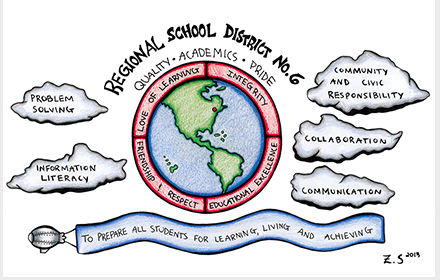
The housecleaning is the easy part. A great deal of time and effort has been spent on making the school look nice to the accreditation team. Considering that our campus is in the bucolic Litchfield Hills of Connecticut, we had a great start. Our building is extremely well maintained, and our maintenance staff has been recognized for their “green” maintenance policies. The final details to housecleaning were the addition of student art on the walls and a large canvas featuring the student designed logo that centers on the motto “Quality, Academics, Pride.”

Preparing the housekeeping was different. Housekeeping required that all stakeholders in our school community reflect on how well do we keep our “house”-our school- running. There have been meetings for the past two years: meetings with community members,  meetings with students, meetings with teachers across disciplines. There have been committees to research eight topics:

  • Core Values, Beliefs, and Learning Expectations
  • Curriculum
  • Instruction
  • Assessment of and for Student Learning
  • School Culture and Leadership
  • School Resources for Learning
  • Community Resources for Learning

After all the meetings came the writing of the reports, and after all the reports came the gathering of the evidence. Finally, the evidence sits in eight bins in a room in the agricultural wing of the school ready for the volunteer accreditation team to review.

What is most striking about the collected evidence is the variety. The evidence today contrasts to the evidence from the accreditation several years ago.  For each lesson plan on paper, there is a digital lesson plan. For each student essay drafted, peer-reviewed, and handwritten on composition paper, there is a Google Doc with peer comments, and to see each draft, one need only check “see revision history.” Whether or not members of the NEASC committee check the revision histories of individual documents is not as important as how they will check the history we have provided in the evidence bins and websites. In looking at the evidence, the NEASC committee will note our academic housekeeping, and they will make recommendations as to how we should proceed in the future.

The entire school community has every right to be proud of Wamogo Regional High School, and recommendations from NEASC will help guide us in the future. But for tonight, the housecleaning and housekeeping is over.  

A message from the Vice Principal arrived by e-mail tonight; she sums up the experience:

When driving home from school this evening, I was thinking about the arduous process we have all been engaged in over the past two years.  I don’t believe there is a single member of our school community that hasn’t played a part in this important preparation.  Many of you worked tirelessly on committees, writing reports, culling evidence, hanging student work, etc., etc., etc.  I just wanted to take a moment and  thank the entire Wamogo community for the rally we have all engaged in to prepare for this important visit.  I know that the visiting school will easily see what a special place Wamogo is and the obvious talents of our staff and students.  I am extremely proud of our school and want you to enjoy showing the visiting committee what wonderful work you are doing with our students.

Welcome, NEASC. Our house is ready.

March Madness is not exclusive to basketball.Screen Shot 2014-03-15 at 1.38.50 PM
March Madness signals the season for standardized testing season here in Connecticut.
March Madness signals the tip-off for testing in 23 other states as well.

All CT school districts were offered the opportunity to choose the soon-to-be-phased-out pen and paper grades 3-8 Connecticut Mastery Tests (CMT)/ grade 10 Connecticut Academic Performance Test (CAPT) OR to choose the new set of computer adaptive Smarter Balanced Tests developed by the federally funded Smarter Balanced Assessment Consortium (SBAC). Regardless of choice, testing would begin in March 2014,

As an incentive, the SBAC offered the 2014 field test as a “practice only”, a means to develop/calibrate future tests to be given in 2015, when the results will be recorded and shared with students and educators. Districts weighed their choices based on technology requirements, and many chose the SBAC field test. But for high school juniors who had completed the pen and paper CAPT in 2013, this is practice; they will receive no feedback. This 2014 SBAC field test will not count.

Unfortunately, the same can not be said for counting the 8.5 hours of testing in English/language arts and mathematics that had to be taken from 2014 academic classes. The elimination of 510 minutes of instructional time is complicated by scheduling students into computer labs with hardware that meets testing  specifications. For example, rotating students alphabetically through these labs means that academic classes scheduled during the testing windows may see students A-L one day, students M-Z on another. Additional complications arise for mixed grade classrooms or schools with block schedules. Teachers must be prepared with partial lessons or repeating lessons during the two week testing period; some teachers may miss seeing students for extended periods of time. Scheduling madness.

For years, the state standardized test was given to grade 10, sophomore students. In Connecticut, the results were never timely enough to deliver instruction to address areas of weakness during 10th grade, but they did help inform general areas of weakness in curriculum in mathematics, English/language arts, and science. Students who had not passed the CAPT had two more years to pass this graduation requirement; two more years of education were available to address specific student weaknesses.

In contrast, the SBAC is designed to given to 11th graders, the junior class. Never mind that these junior year students are preparing to sit for the SAT or ACT, national standardized tests. Never mind that many of these same juniors have opted to take Advanced Placement courses with testing dates scheduled for the first two full weeks of May. On Twitter feeds, AP teachers from New England to the mid-Atlantic are already complaining about the number of delays and school days already lost to winter weather (for us 5) and the scheduled week of spring break (for us, the third week of April) that comes right before testing for these AP college credit exams. There is content to be covered, and teachers are voicing concerns about losing classroom seat time. Madness.

Preparing students to be college and career ready through the elimination of instructional time teachers use to prepare students for college required standardized testing (SAT, ACT) is puzzling, but the taking of instructional time so students can take state mandated standardized tests that claim to measure preparedness for college and career is an exercise in circular logic. Junior students are experiencing an educational Catch 22, they are practicing for a test they will never take, a field test that does not count. More madness.

In addition, juniors who failed the CT CAPT in grade 10 will still practice with the field test in 2014. Their CAPT graduation requirement, however, cannot be met with this test, and they must still take an alternative assessment to meet district standards. Furthermore, from 2015 on, students who do not pass SBAC will not have two years to meet a state graduation requirement; their window to meet the graduation standard is limited to their senior year. Even more madness.

Now, on the eve of the inaugural testing season, a tweet from SBAC itself (3/14):

Screen Shot 2014-03-15 at 1.28.22 PM

This tweet was followed by word from CT Department of Education Commissioner Stefan Pryor’s office sent out on to superintendents from Dianna Roberge-Wentzell, DRW, that the state test will be delayed a week:

Schools that anticipated administering the Field Test during the first week of testing window 1 (March 18 – March 24) will need to adjust their schedule. It is possible that these schools might be able to reschedule the testing days to fall within the remainder of the first testing window or extend testing into the first week of window 2 (April 7 – April 11).

Education Week blogger Stephen Sawchuk provides more details in his post  Smarter Balanced Group Delays in the explanation for the delay:

The delay isn’t about the test’s content, officials said: It’s about ensuring that all the important elements, including the software and accessibility features (such as read-aloud assistance for certain students with disabilities) are working together seamlessly.

“There’s a huge amount of quality checking you want to do to make sure that things go well, and that when students sit down, the test is ready for them, and if they have any special supports, that they’re loaded in and ready to go,” Jacqueline King, a spokeswoman for Smarter Balanced, said in a March 14 interview. “We’re well on our way through that, but we decided yesterday that we needed a few more days to make sure we had absolutely done all that we could before students start to take the field tests.”

A few more days is what teachers who carefully planned alternative lesson plans during the first week of the field test probably want in order to revise their lessons. The notice that districts “might be able to reschedule” in the CT memo is not helpful for a smooth delivery of curriculum, especially since school schedules are not developed empty time slots available to accommodate “willy-nilly testing” windows. There are field trips, author visits, assemblies that are scattered throughout the year, sometimes organized years in advance. Cancellation of activities can be at best disappointing, at worst costly. Increasing madness.

Added to all this madness, is a growing “opt-out” movement for the field test. District administrators are trying to address this concern from the parents on one front and the growing concerns of educators who are wrestling with an increasingly fluid schedule. According to Sarah Darer Littman on her blog Connecticut News Junkie, the Bethel school district offered the following in a letter parents of Bethel High School students received in February:

“Unless we are able to field test students, we will not know what assessment items and performance tasks work well and what must be changed in the future development of the test . . . Therefore, every child’s participation is critical.

For actively participating in both portions of the field test (mathematics/English language arts), students will receive 10 hours of community service and they will be eligible for exemption from their final exam in English and/or Math if they receive a B average (83) or higher in that class during Semester Two.”

Field testing as community service? Madness. Littman goes on to point out that research shows that a student’s GPA is a better indicator of college success than an SAT score and suggests an exemption raises questions about a district’s value on standardized testing over student GPA, their own internal measurement. That statement may cause even more madness, of an entirely different sort.

Connecticut is not the only state to be impacted by the delay. SBAC states include: California, Delaware,  Hawaii, Idaho, Iowa, Maine, Michigan, Missouri, Montana, Nevada, New Hampshire, North Carolina, North Dakota, Oregon, Pennsylvania, South Carolina, South Dakota, U.S. Virgin Islands, Vermont, Washington, West Virginia, Wisconsin, Wyoming.

In the past, Connecticut has been called “The Land of Steady Habits,” “The Constitution State,” “The Nutmeg State.” With SBAC, we could claim that we are now a “A State of Madness,” except for the 23 other states that might want the same moniker. Maybe we should compete for the title? A kind of Education Bracketology just in time for March Madness.

Shakepeare winkingPlanning on teaching literature in high school? I suggest a brush up on literary pitfalls….and work on developing a sense of humor because sooner or later, a student, (usually a boy) will come upon one of the following words in some great work of literature:

Screw.
Bang
Bosom.
Laid.
Nuts.

In context, these words have been carefully chosen by an author to express some lofty ideal.  Yet, to that student who is looking for any way to make the class more entertaining, these words can mean something else entirely.

No author has been more successful in creating linguistic traps than Shakespeare. There are the overt references, such as Lady Macbeth’s startling announcement to “Unsex me here..!” (I.5) in preparation to assassinate the visiting King Duncan.  There are the more subtle problems with the “hoary-headed frosts” in Midsummer Night’s Dream, but Romeo and Juliet offers the most opportunity for student sniggering.

From the opening scuffle where, “My naked weapon is out”, a teacher must negotiate students through Lord Capulet’s Give me my long sword, ho“,  Mercutio’s  teasing  “Prick love for pricking,” or the Nurse’s explanation that Juliet “shall bear the burden soon at night.

“Is Shakespeare always this dirty?” I see the quizzical looks on their faces.
“Your parents are okay with this,” I reassure them, “Besides, this is required reading.”

The Bard does not have a monopoly on creating awkward moments with language in class. Students are capable of creating discomfort, intentionally or not.

Years ago, I taught an Animal Farm unit and delivered a lesson on George Orwell’s characters and their historical counterparts. I explained that Napoleon was Stalin, the dogs were his secret police, and Snowball was Trotsky. I mentioned in passing that Trotsky was considered an insurrectionist, and I paused to let the information sink in. Instead I heard the distinct sound of giggling from several of the boys in the back of the room.

“What is so funny?”I demanded.
“Nothing,” they stammered.
I should have stopped there, but I moved in to clarify.
“What do you think I said? Do you know what an insurrectionist is?”

There was a pause…
“When… it… goes down?” blurted out one of the offenders.

“No,” I was indignant…not to be stopped. “No, I said’ insurrection’…what did you think I …..”
Then it hit me.
Erection.
I doubled back.
“It’s someone who is trying to start an uprising…..”
That explanation was drowned out with guffaws.
Did I mention that a very good sense of humor is needed in with sophomores?

This past fall, I had posted charts around the rooms with questions associated with Oliver Twist.
As the students moved around the room I noticed students giggling when they got to one of the charts.
“Why would someone lie?” was the heading on the chart.
“To get laid,” was scribbled in small print.
I recognized that print.
That print belonged to Mitch. Mitch who stood all of 4’2″ and was 90 lbs, soaking wet.

Everyone had seen it, so I needed to address the problem quickly.
“Mitch,” I demanded, “is that an appropriate thing to write?”

“Sure, Ms. B,” he replied casually,”I could lie and say I’m dying…Like in the movie 50/50.
I had to admit he was using logic…to say nothing of his confidence.
He still erased the comment.

Next week, I plan to use an Advanced Placement Literature multiple choice prompt from Jane Austen’s Northanger Abbey as practice for the upcoming AP exam.  I was rereading the passage to check its length and the matching questions when I came upon the line, “She began to curl her hair and long for balls.”

Oh, Jane. That’s going to definitely cause a stir!

There is no surprise in reading the word “precision” in the language of the Common Core’s Mathematical Practice Standards. Mathematics requires precision:

CCSS.Math.Practice.MP6 Attend to precision.

Mathematically proficient students try to communicate precisely to others. They try to use clear definitions in discussion with others and in their own reasoning.

Writing requires precision as well. Proficient writers in every genre communicate precisely to others. Yet, one of the most difficult concepts to teach to students in recognizing the precision in an author’s craft. Word choice and punctuation are committed with intent by an author, yet, there are students who doubt these steps of precision made by an author. They believe that any text has stepped, as if full-formed or Athena-like, from the mind of an author. They think that novels pop into existence…unless, they are reading Toni Morrison.

Screenshot 2014-02-27 21.57.19

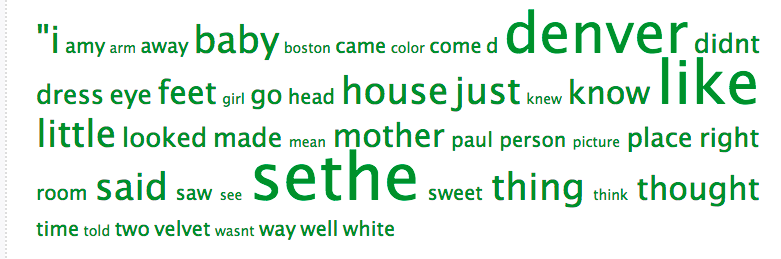
A “Wordsift” of precise language in Chapter 3 of “Beloved”; Denver and Sethe dominate as does the simile generator “like”.

My Advanced Placement English Literature students are currently reading Morrison’s 1988 Pulitzer Prize winning novel, Beloved. This story confronts the horrors of slavery by fictionalizing the true story of Margaret Garner who, in a failed bid for freedom, killed her baby daughter rather than have her returned to slavery.

A look at the opening two lines to Toni Morrison novel Beloved demonstrate her power as a storyteller and highlight her precision with language:

“124 was spiteful. Full of baby venom.”

An quick analysis of the specificity of language in these two short statements reveals:

  • 124 is the address (setting) where Paul D arrives looking for the run-away slave, Sethe.
  • 124 is also a combination of 1and 2 and 4…the first-born, the second-born, and the fourth-born children of Sethe. The third-born child (3), the child named Beloved, is missing numerically. That child chooses to make her presence known in more ghostly ways.
  • Morrison is exacting in her selection of word choice from her opening personification of the house as spiteful (“having or showing a desire to harm, anger, or defeat someone; malicious”) to the incongruous pairing of the words “baby” and “venom”.

So, when I asked students to write about the precision in word choice Morrison uses to craft imagery in the novel in the first 100 pages, they had much to choose from:

“In describing the choke cherry tree of scars on Sethe’s back, Morrison writes, ‘See, here’s the trunk it’s red and split wide open, full of sap and here’s the parting for the branches'(79). A history textbooks do not give details of slave wounds like that.”

“Sethe and Denver even accept ‘the lively spite the house felt for them'(3) …. Morrison utilizes this personification to show how objects took on the role of companionship when Sethe and Denver were ignored by their community.

“Sethe describes seeing the sunrise as menacing with ‘red baby blood’ with ‘pink gravestone chips'(34)  instead of seeing the colors as warm and inviting.”

In making these and other observations, students called attention to Morrison’s specific use of dialect, alliteration, hyperbole, synecdoche, repetition, smilies, symbols as well as the differences in syntax to serve her purpose in making the reader confront the irreparable harm of slavery. The closer the students read, and they were “close reading”, the more appreciative they became of Morrison’s style. They became more appreciative of her power to select specific words in creating a particular image. They had no idea they could have just as easily be applying a mathematical practice standard (“attend to precision”) in their literary analysis.

Morrison was awarded the Nobel Prize in 1993 in for her body of work that included the novel Beloved. In her acceptance speech, she addressed how precise language is used to describe; to depict [as if] by painting or drawing:

The vitality of language lies in its ability to limn the actual, imagined and possible lives of its speakers, readers, writers. … When a President of the United States thought about the graveyard his country had become, and said, “The world will little note nor long remember what we say here. But it will never forget what they did here,” his simple words are exhilarating in their life-sustaining properties because they refused to encapsulate the reality of 600, 000 dead men in a cataclysmic race war. Refusing to monumentalize, disdaining the “final word”, the precise “summing up”, acknowledging their “poor power to add or detract”, his words signal deference to the uncapturability of the life it mourns.

Morrison’s admiration for Lincoln’s precise language in the Gettysburg Address is a shared admiration. The speech is a suggested 9th/10th grade text for the Common Core Common Core State Standards for Literacy in History/Social Studies. Moreover, educators should note the literary connection between the president who led the nation to abolish slavery with authors like Morrison who use their craft in pressing the reader to face the horrors of slavery.

Finally, the Mathematical Practice Standard #6 states that by high school, students will “have learned to examine claims and make explicit use of definitions.” There could be no better claim on the damage inflicted on humans in bondage than Morrison’s story of Sethe and her Beloved.  The last lines of the novel, “This is not a story to pass on” communicates “You [reader] may not pass [or avoid] this story.” She explicitly defines the experiences of those “60 million or more” and captures their love and their longing for familial bonds by writing precisely what they could not.

Cat in the HatMarch 2nd is Theodor Geisel’s (aka Dr. Seuss’s) birthday.

March 2nd is Read Across America Day as well, and Read Across America is an annual nationwide reading celebration sponsored by the National Education Association (NEA).

The impact of Dr. Seuss’s texts on young readers is enormous, but the impact does not stop there. Even at the high school level, I have made extensive use of Dr. Seuss’s classic The Cat in the Hat. I have posted about using this text to introduce Freudian psychology in I Wish I Had Thought of Id, Ego, and the Superego in Dr. Seuss’s “The Cat in the Hat”.

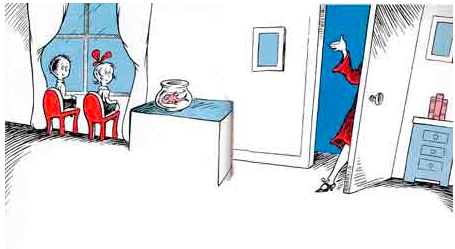
At the end of that lesson, my students have a clear understanding about the differences between the Id, represented by the wild Thing 1 and Thing 2, and the Superego, represented by the dutiful Fish. The also have one lingering question:

“Does the Cat want the kids to lie to their Mom?”

Their question encouraged me to look more closely at the text as a possible means to introduce other literary concepts. But I am not the only one who thought there were other lessons to be gained from this text. I recently found a series of philosophical topics and questions for The Cat in the Hat on The Teaching Children Philosophy Wiki

The home page states:

This website is dedicated to helping adults conduct philosophical discussion with and among elementary school children.Contrary to what many people think, young children are both interested in and good at discussing philosophical questions. Picture books are a great way to initiate a philosophical discussion with young children and this site will help you get started.

Along with a long list of picture books, there are a number of Dr. Seuss texts represented on this wiki including Green Eggs and Ham for educators to teach a lesson on arguing reason vs. experience by Taiba Akhtar or The Sneetches for lessons on defining differences and noting prejudice by Lena Harwood.

The lesson for The Cat in the Hat was posted by Joey Shaughnessy and includes five topics and related follow-up questions, some of which include:

Trust

The Cat reassures the children that what he is doing is okay and that their mother won’t mind…

  • Would have you trusted the cat?
  • When can you trust strangers? What if they’re a teacher, or a policeman?
  • How do you know that you can trust your friends?
  • What is trust?

Responsibility

The Cat, with all of his games, made quite a mess in Sally and Sam’s house…

  • Is it okay that the Cat made a mess?
  • Since the Cat cleaned up his mess, was it more okay that he made it?
  • When is it okay to make a mess?

Wrongness

In the story, Sally and Sam had a very different view on what is right and wrong than the Cat did…

  • Is it okay if the children were entertained by the Cat, even though what he was doing was dangerous?
  • Is it okay to do things that are wrong to try and impress people?
  • Is it more okay to do something wrong if it’s fun? Why or why not?

Social Expectations

In the story, the Cat invited himself in, and started taking action…

  • Was what the Cat did an okay way to act?
  • What are inappropriate things to do in a friend’s home?
  • What makes them inappropriate?

Lying

At the end of the story, the reader is left to wonder if they would tell their mom what had happened…

  • Would have you told your mother what happened? Why?
  • Is it okay to lie to hide something that you’ve done wrong?
  • If we lie and get away with it, can people still be hurt by what we’ve done?
  • Should we tell the truth, even if no one would believe us?
  • If you tell someone only part of what happened, is this lying?

Screenshot 2014-03-02 19.37.23The last question (If you tell someone only part of what happened, is this lying?) was easy to discuss. My students agreed telling someone only part of what happened was lying.

They also mentioned something about speaking from experience.

Perplexed: adj.

1. bewildered; puzzled.
2. complicated; involved; entangled.

(o _ 0 )  ?

I am perplexed as to why this word is on the EngageNY first grade vocabulary list, and again perplexed when I review the first grade units for English Language Arts (ELA) on this website. I am perplexed because I can see that several units in our current grade five curriculum (Early Settlers and the American Revolution) and our entire grade six curriculum (Ancient World History) have  been bundled into a series of units that will be taught in first grade.Did I mention that EngageNY complicates these areas of study with content area lessons on the human body and astronomy in first grade?

All these complications have me even more perplexed as to why so many people are recommending that educators visit and use EngageNY resources. In two separate incidents over the past two weeks, I have heard educators from the State of Connecticut recommend the site. One recommendation was made directly to the Commissioner in the State Department of Education, Stephan Pryor, during a roll-out of the state’s Common Core website. I hope he does not take these recommendations seriously.

Remember that the Common Core State Standards (CCSS) were supposed to guide teachers to teach less and focus more. The CCSS were promoted as a means to stop instruction that is “a mile wide and an inch deep.” The CCSS were promoted to allow teachers to select their own materials, an opportunity to move away from scripted programs, stating,”Teachers are thus free to provide students with whatever tools and knowledge their professional judgment and experience identify as most helpful for meeting the goals set out in the Standards.”

Engage NY curriculum contrasts with these both of these goals; it is both staggering in its breadth and it is highly scripted.

A look at the Grade One English Language Arts curriculum in the “Listening and Learning Strand” demonstrates the breadth in a curriculum that is organized into 11 separate content area Domains. An examination into Domain 4, titled “Early World Civilizations” shows a unit that is 21 days in length for 6 year-old students using  a Tell It Again! Read-Aloud Anthology. Engage NY explains that this unit:

“….for Early World Civilizations contains background information and resources that the teacher will need to implement Domain 4, including an alignment chart for the domain to the Common Core State Standards; an introduction to the domain including necessary background information for teachers, a list of domain components, a core vocabulary list for the domain, and planning aids and resources; 16 lessons including objectives, read-alouds, discussion questions, and extension activities; a Pausing Point; a domain review; a domain assessment; culminating activities; and teacher resources.”

A further examination of Domain 4 means reviewing its 81 student objectives. That number is not as intimidating as the language in the content area objectives. The first ten objectives state that “by the end of this unit, students will be able to….”:
  1. Locate the area known as Mesopotamia on a world map or globe and identify it as part of Asia;
  2. Explain the importance of the Tigris and Euphrates Rivers and the use of canals to support farming and the development of the city of Babylon;
  3. Describe the city of Babylon and the Hanging Gardens;
  4. Identify cuneiform as the system of writing used in Mesopotamia;
  5. Explain why a written language is important to the development of a civilization;
  6. Explain the significance of the Code of Hammurabi;
  7. Explain why rules and laws are important to the development of a civilization;
  8. Explain the ways in which a leader is important to the development of a civilization;
  9. Explain the significance of gods/goddesses, ziggurats, temples, and priests in Mesopotamia;
  10. Describe key components of a civilization…
Consider the readiness for first graders to meet these content objectives, and consider their readiness in meeting  other content area objectives in this unit including:
#16 Explain the significance of gods/goddesses in ancient Egypt;
#26 Define monotheism as the belief in one God….

The problem with these content area objectives is that the response, (and remember this is a six year old’s response), is limited to a shallow or cursory understanding to any of these larger questions. Entire courses at higher grade levels, middle and high school, have been developed around these objectives, and many of these objectives will be repeated again in these higher grade levels.

Next, consider that the unit that follows Domain 5-Early American Civilizations, is dedicated to a study of the Aztec, Mayan, and Incan societies. These first 10 objectives for Domain 5 state that “the student will be able to….”

  1. Explain that a shift occurred from hunting and gathering to farming among early peoples; compare and contrast hunter-gatherer societies and Mayan society;
  2. Explain the importance of extended family to the Maya;
  3. Identify the areas in which the Maya/Aztec/Inca lived;
  4. Explain that the Maya/Aztec/Inca farmed;
  5. Explain that the Maya/Aztec/Inca developed large cities or population centers, or empires, many, many years ago;
  6. Explain that the Maya/Aztec/Inca had leaders (kings or emperors); identify by name the emperor of the Aztec, Moctezuma;
  7. Explain that the Maya/Aztec/Inca each had a religion;
  8. Describe the significance of the stars and planets to the Maya;
  9. Explain the significance of the Mayan calendar;
  10. Identify the Aztec capital as Tenochtitlan; identify that Machu Picchu is an Incan city…
There are 32 more objectives for students in Domain 5, and there are nine other domains with an equally daunting number of “the student will” objectives in the Listening and Learning strands. There are more objectives, with overlap, in the Skill strands for each of remaining nine Domains. According to the curriculum in EngageNY, a first grader would be expected to have a basic understanding of Early World Civilizations and Early American Civilizations as well as these remaining nine domains:

Domain #1: Fables and Stories
Domain #2: The Human Body
Domain #3: Different Lands/Similar Stories
Domain #6: Astronomy
Domain #7: The History of the Earth
Domain #8: Animals and Habitats
Domain #9: Fairy Tales
Domain #10: A New Nation: American Independence
Domain #11: Frontier Explorers

The most striking characteristic of this list of domains is the breadth of content area material that a first grader (remember, these are 6 year-olds), is required to “explain” or “identify” or “describe.” These are at best low level comprehension skills in Bloom’s taxonomy. This list clashes with the CCSS objective to become “more focused and coherent” especially when this list of domains does not appear to be connected by any central theme; their inclusion appears random.

All this content will be important to developing a student’s background knowledge over the course of several years, but how critically important is this material at the first grade level when instruction time is at a premium? Practice in reading and writing should be a priority, and the content used for in the development of reading and writing skills should not overwhelm students, but rather complement student cognitive ability.

Nevertheless, EngageNY provides equally dense ELA curriculum at each grade level. Students often “revisit” content that they may not have understood earlier, an enterprise that could be unnecessary given the cursory treatment that may given a topic at an earlier grade level (example: studying War of 1812 in grade 2).

Like any other website with lessons aligned to the CCSS, teachers may find value in some resources on EngageNY. A cautionary note, however, is that these are not “teacher-tested” lessons, but highly scripted lessons from the juggernaut of publishing and testing, the UK based Pearson. This raises a frightening scenario of having the creators of student achievement tests (Pearson) hold teachers and students accountable for the content they (Pearson) have also created in the lessons.

Connecticut’s adoption of the CCSS should remain true to its stated goals of allowing teachers to select their own materials in the development of focused curriculum at each grade level. The damage may already be done, however, since the website Pryor was offering in the state rollout of the Common Core already contains numerous links to EngageNY resources.

Which brings me to another 1st grade word on the EngageNY vocabulary list.
Apoplexy.

“Stand up…. Now, put out your arms,” the instructor stood watching us.

“OK, pull your right arm back past your body.”Screenshot 2014-02-09 06.56.12

This was a EDR 500 level class, a graduate course in teaching remedial reading to pre-school and elementary aged schoolchildren. On this first night, we did not know what to expect.

“Now try with the other arm.”
We waved our arms erratically in the air.
He paused for a moment, looked amused and asked, “Can you teach someone to swim like this?”

The 26 of us were standing in a very dry classroom with no water in sight.

We all shook our heads in agreement, “No”, “Not Really”, “Probably not.

“Well, how can you learn to teach reading without actually working with students?”
We were surprised. Our instructor was admitting to the disconnect in teacher preparation programs.
“You need to be in the classroom to learn how to teach,” he admonished, “any thing else is waving your arms in the air.”

In this class, we were a mixed group in age and experience. Some of us were already employed as teachers in classrooms; others were completing degrees in order to be hired. All of us were learning how to improve student reading from 4:30-7:30 PM on a Tuesday night in a classroom. With not a student in sight, we were learning in the abstract.

Learning in the abstract is not unusual. A large percentage of learning for students in pre-K through grade12 is spent learning in the abstract. For 13 years, students practice skills they will use in college or in real world careers.

However, for those preparing to be teachers, the “real world” is the classroom. Our instructor was acknowledging that the classroom environment is the pool and prospective teachers and veterans should be immersed in that pool in order to learn how to teach. Unfortunately, the evening time slot and location of the class distanced us from authentic practice.

Accessing classrooms and students for teacher prep is largely unavailable under our current agrarian model of education. There are logistical problems for colleges and universities in scheduling, supervision, and, in today’s tense climate, security. Nevertheless,hands on classroom experience is a critically important part of undergraduate teacher preparation, and a semester or two of supervised student teaching is not enough. Teaching training programs need regular and continuous access to students. At minimum, there are must be more integration and collaboration between the teacher training programs, graduate and undergraduate, and local classrooms that are geographically located near these programs. 

In addition, the professors/instructors in teacher preparation programs must be current in the practices that new teachers are expected to know. They must be current on how their state is integrating the Common Core State Standards, the surrounding controversies around the adoption of these standards, and the testing programs that have been funded to access the effectiveness of these standards.

Also professors/instructors must be current in their state’s evaluation programs and how the teacher competencies being evaluated. Information disseminated through handouts and powerpoint presentations on these topics is not sufficient; classroom practice in teaching strategies through simulations, feedback, reflection and extensive discussions on these standards and evaluation procedures are critically important at every level of teacher training.

Finally, the professors/instructors in teacher training programs must be familiar with the wide range of technologies being used in preK-grade 12 classrooms. The disconnect between college programs and the use of technology in real-life classrooms has been widening. The professors/instructors in today’s teacher preparation programs must develop proficiency with the software teachers are expected to use. They must be familiar with Google Apps for Education, Edmodo, Twitter, Quizlet, Dropbox, Khan Academy, Class Dojo, Pinterest, Evernote.

There are forces outside the education profession that are exerting pressure and changing the face of education for new and seasoned educators alike. There is political pressure from legislators designing state evaluation and curriculum standard programs combined with pressure from testing companies. The voice that is missing in response to these pressures is leadership from those who design and implement teacher training programs in colleges and universities.

Leadership is more than just an advertising slogan or an elective course offered by colleges and universities. Teacher training programs need the leadership of professors/instructors who connected with the realities of the classroom. That kind of leadership requires direct involvement and reflection on the curriculum, instruction strategies, and means of assessment in classrooms today.

Only that kind of leadership can design programs that meet the needs of the classroom today as well as anticipate the training that prepares new and veteran teachers with both pedagogy and experience for success.

sport-graphics-swimming-528905

In this current sea change of education, teacher training programs must become the force that exerts pressure and change, not the institutions forced to respond. Teacher training programs currently offered by colleges and universities must move from the abstract, from the practice of training on dry land, in order to move teacher preparation into deep waters of classroom experience. 

Anything else is just waving arms in the air.