Just back from one of my favorite library book sales-the winter book sale in Westport, Connecticut, which is running during the St. Patrick’s Day weekend. The “luck of the Irish” provided sun and spring-like temperatures; the advertised “winter sale” was a misnomer.

Seven bags with an average of 17 books a bag=119 books;
total price? 122.50 or roughly $1.00/book!

The Friends of the Westport Library is responsible for the organization of this winter sale and for the outdoor summer sale as well. While many CT libraries offer quality books at their library book sales, the Westport library book sales always offer quality books in great quantities! This particular sale featured hardcover, paperback and and trade fiction, and many tables dedicated to videotape.

The volunteer Friends of the Library that work the checkout table are polite and accommodating. There are also helpful volunteers who tidy the tables sorting books into their genres. I was particularly fortunate to have one volunteer see my growing bag contents and offer to tally the books in the hold section while I continued to shop. Checkout for this sale, as it was with the summer sale, was fast and efficient, despite the number of books I gathered.

This Saturday morning, the sale was particularly rich with young adult (YA) novels. I averaged 17 books in a bag, and purchased seven bags of books. Most of these books were single copies of books on my “must have” list, for example, I picked up a single copy of Nancy Farmer’s House of the Scorpion and a single copy of James Dasner’s Maze Runner.
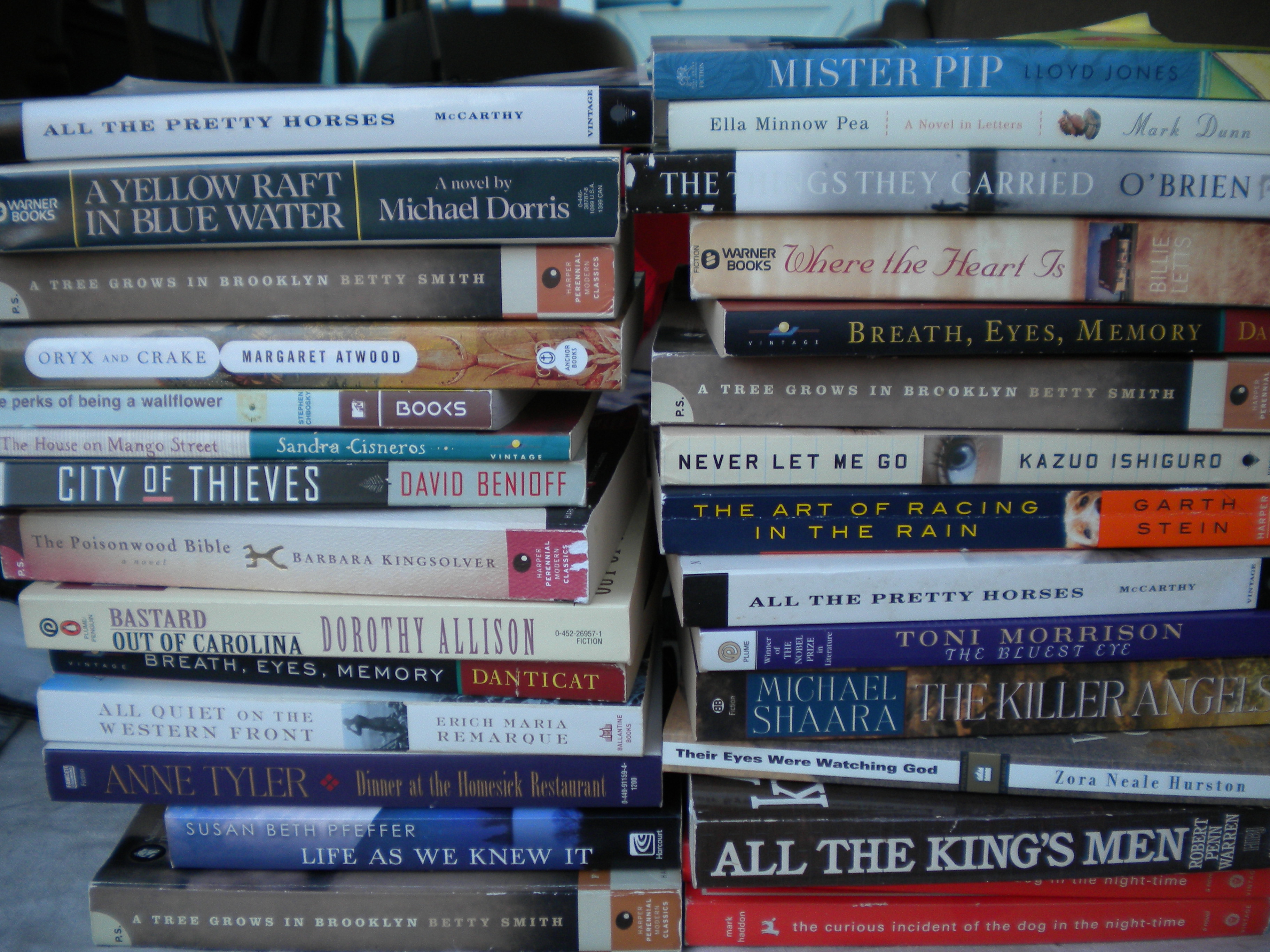
Books for high school students grades 10-12

But there were also a number of copies of books we teach in our curriculum. On this trip, I picked up five copies of Laurie Halse Andersen’s Speak, four copies of Avi’s Nothing but the Truth, and a dozen copies of Betty Smith’s classic A Tree Grows in Brooklyn. There were also copies of contemporary novels that are popular with the high school students. These include Paulo Coelho’s The Alchemist, Mark Haddon’s The Curious Incident of the Dog in the Night-time, and Curtis Sittenfield’s Prep.
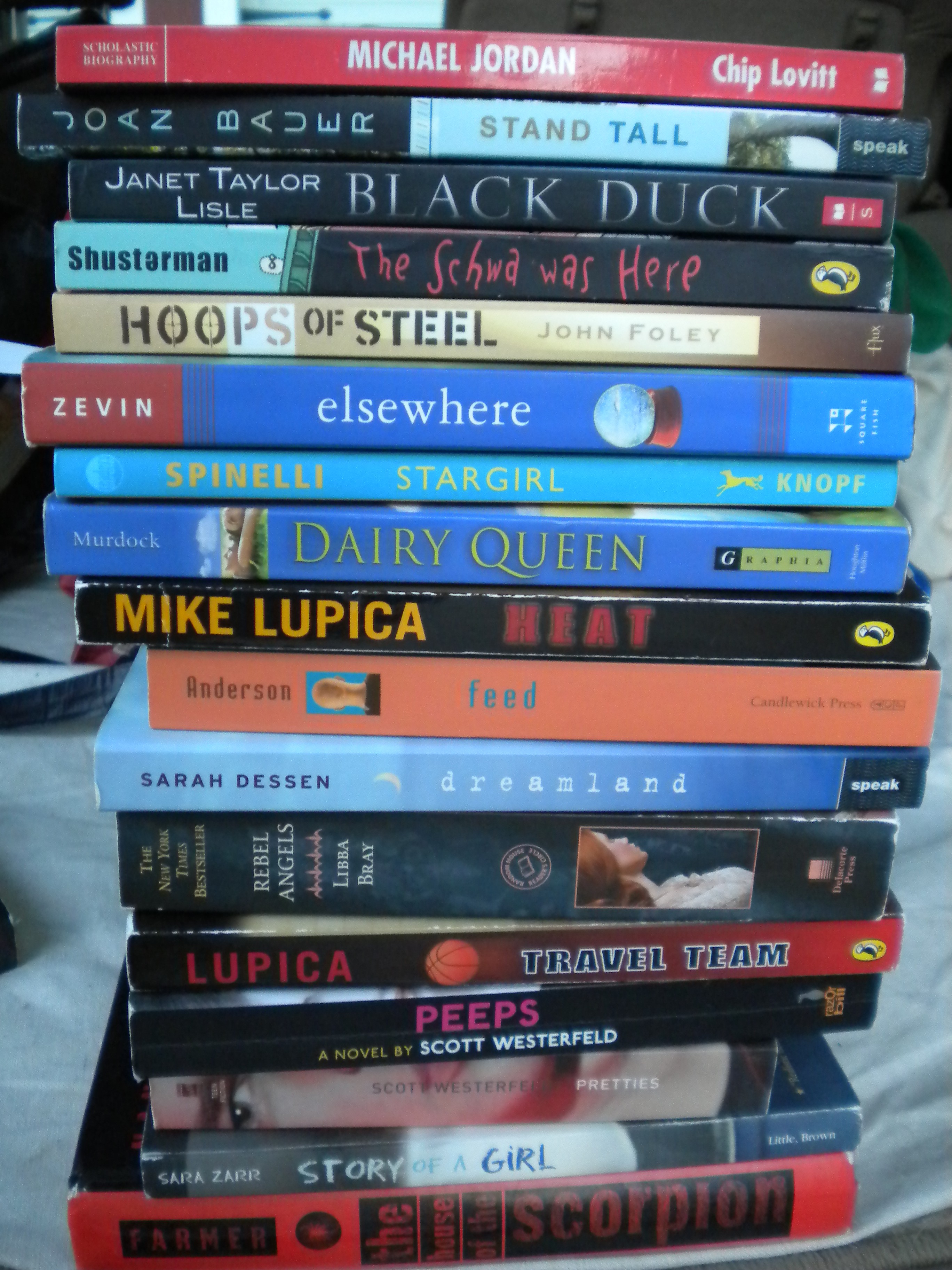
These 17 books can be purchased new for the retail price of $122.98.

I spent a total of $122.50 on used books at this sale for 119 books for grades 7-12. This amount of money represents the retail price ($122.98) of the 17 books in the picture if we had purchased the books brand new. Because of this used book sale, our payment to the Friends of the Westport Library allows us to afford an additional 102 books for our classroom libraries.

The purchase of gently used books continues to be a great resource for our classroom libraries. Our expansion of titles through used book purchases allows our students to independently select a book to read and allows teachers to create literature circles with a variety of reading materials for different reading levels.

The proceeds from these used book sales directly benefit local libraries, while these used books are “recycled” from one reader to another. The Westport Public Library Giant Summer Book Sale, will be held July 21-24, 2012. I will be there, and I encourage you to go as well!

 The marathon of testing  is over! In the State of Connecticut, the two week window for the Connecticut Mastery Tests (CMT -elementary) and the Connecticut Academic Performance Test (CAPT grade 10) has ended, and some teachers are looking at the two week “hole” in grade books and unit plans that the intensive state testing created.

While education experts strongly advocate against “teaching to the test” and advocate the development of skills, most classroom teachers feel some obligation to prepare students for the tests by simulating at least one timed practice session for a specific test. Our state releases past testing materials for each discipline, and to be honest, our students do a fair amount of practice with these released materials before the test.

For the past two weeks, the daily school schedules have been modified to accomodate early morning testing sessions. During the school day, the lessons for students who have spent a grueling 45-90 minutes calculating or writing have been modified as well. For example, when they finally have  attended English classes, our tenth grade students have been provided silent sustained reading time for books they have independently chosen or have been watching videos to supplement a world literature unit on people in conflict.

The reading or Response to Literature test, associated with English classes,  requires students to read a short story and then write four lengthy  responses. Sadly, year after year, the quality of the story on this test pales in comparison to the classic short stories a student will encounter in even the most limited literature anthology. So we prepare students how to respond to  a question that asks “Is this good literature?” with even the most mediocre story.  Now that that the test is over,  students will begin the epic poem Beowulf, and the teachers are looking forward to having the students engage with this 8th Century grandfather of literature. We are ready for some “epic-hero-wrenching-monster’s-arm” action.

The writing or Writing Across the Disciplines test, associated with social studies, requires students to read newspaper articles about a controversial  topic, take a position on the controversial topic, and then develop a persuasive argument. There is absolutely no content from the social studies curriculum, in this case Modern World History, associated with the test. Now that this test is over, teachers can return to history content outlined in their curriculums; back to the arrival of the American forces on the shores on Iwo Jima and in the forests of the Ardennes.

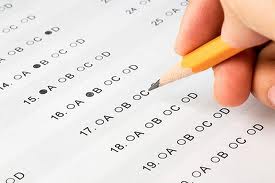
Pencil and scantron testing is not an authentic practice in the world outside the classroom, but I am not against testing as a means to determine student progress; I accept that some form of testing is inevitable in education. However, the past two weeks of reading instructions (“Does everyone have two #2 pencils?”), writing in booklets (“Stop. Do not turn page”),  and racing against the clock (“You have 10 minutes left”) has taken a toll on students and faculty alike. Everyone is looking forward to the routine of a regular schedule.

Wearily, our students climbed the stairs for the last time this morning after taking the final  “supplemental” test, an extra assessment given to test materials for future test-takers. The students’ time in the testing crucible had passed; their scores will be posted during the the lazy days of summer when this experience will be nothing but a memory. Hopefully, they will have done well, and we will be pleased with the results.

Post-CAPT, there are several weeks left in the third quarter, and one full quarter after that.  Teachers can return to content without incorporating CAPT preparation with clear consciences. Our tenth graders will have the chance to read Macbeth where they will have the opportunity to create and respond to more significant questions than “Is this good literature?”  The importance of this great play placed against the activities of the past two weeks puts me in the mind  to parody Shakespeare’s famous speech-

Out, out, two weeks of testing
The CAPT is but a walking shadow, a poor player,
That struts and frets his hour upon the stage,
And then is heard no more. It is a test,
mandated by others, full of sound and fury,
Signifying nothing.

I am passing out Brave New World to the 10th graders.
“Is there an audiobook for this?” a student asks.
“Why not just read the book?” I respond.
“I can’t read this without help,” explains the student.
“I’ll see,” I sigh.

I admit that in the past I had been a little frustrated at these requests. I felt as though the students were sometimes “cheating” at reading. I felt they were not technically “reading”, the complex cognitive process of decoding symbols in order to construct or derive meaning. They were “listening”, where they  make an effort to hear  or to heed something. However, I have become slowly converted in the use of audiotexts for difficult texts because I have seen how effective they are as a resources in my classrooms.

"To audiotext or not to audiotext?"

The reason for considering the use of an audiotext  is what I call the problem of “voice”. What students may be telling me when they say they need help is that they do not hear the voice of an author (narrator) or the voice of a character while reading a text. A good reader can hear voice as he or she reads, but the struggling reader may need an audiotext to provide that voice.

The use of audiotexts in our English/language arts classrooms has been gradual as we build up our resources. There are a limited number hard copies of required texts in the school  library, so we look for resources available on the web. The use of the audiotext in whole class reads has been particularly effective with short passages, poems or plays.  For example, there is an excellent audio version of The Adventures of Huckleberry Finn available for free on the site Loud Lit.org. The narrator is particularly good with the voices of Jim and Huck, (hear Ch. 2)  and the site provides the page by page text as a “read-along”. The problems of Twain’s use of dialect are minimized once the students can hear the language. Equally good on this site is the audio-text for Jack London’s “To Build a Fire” which we have used in a 9th grade short story unit.

Additionally, YouTube provides a multitude of poetry readings from T.S. Eliot reading his The Love Song of J. Alfred Prufrock to animated versions of Billy Collin’s poems “The Dead” and “Forgetfulness”.

However,  I still wondered, was I educationally sound in incorporating these audiotexts in the classroom? (pun intended)

The question of audio text vs. written text has been studied for the past 40 years as audiotexts have grown in accessibility and popularity. In 1977, Walter Kintsch and Ely Kozminsky conducted an experiment where “48 college students either listened to or read 3 tape-recorded stories, each about 2,000 words in length. Immediately after processing each story, students wrote a summary in 60–80 words. A comparison of the summaries written after reading with those written after listening revealed only minor differences” (Journal of Educational Psychology).

More recently, a study conducted in 2003 in six high schools in the Northeast posed the question, “Does the use of audio texts with and without a comprehension strategy enhance the content acquisition for high school students with mild cognitive disabilities enrolled in US government classes in self contained settings?” They used audio textbooks and a reading comprehension strategy (SLiCK) and concluded that “that audio text books can be an effective tool to for increasing content acquisition for secondary students with mild disabilities.”  The original hypothesis that the experimental group with the added intervention of SLiCK would out perform the audio book and control group, was not proved since there was no significant difference between the two experimental groups. Instead, the findings suggest “that the use of audio books for students with mild disabilities can improve content acquisition and increase understanding of content on students’ grade level and student independence with reading assignments.” The study was featured in an article (9/12/11) in Forbes by Olga Khazan titled, Is Listening to Audio Books Really the Same as Reading? Khazan suggested that the findings demonstrating the improvement in comprehension need not be limited to students with mild disabilities.

Apparently, how students receive information is not as different as one might think. University of Virginia psychology professor Dan Willingham, was also featured in the Forbes article saying, “There isn’t much individual variance in the way people absorb information.The way this is interpreted is that once you are good at decoding letters into sound, which most of us are by the time we’re in 5th or 6th grade, the comprehension is the same whether it’s spoken or written.”

While the physical text can be helpful for a student to re-read or annotate,  the audiotext can help with the prosody or musicality of words. With a good audiotext, “Someone who knows the meaning can convey a lot through prosody,” Willingham states, “if you’re listening to a poem, the prosody might help you.”  The same is true for reading a play. When we read the play Macbeth in class, I reach for the dramatized audio version (on cassette tape) by Caedmon featuring Anthony Quayle as Macbeth. The students do read the text aloud themselves, but then have an opportunity to hear the play’s lines spoken with the dramatic nuances and intonations that make Shakespeare’s language meaningful.

I am not the only one who weighs whether the written text or audiotext are the same experience. An informal survey (1950 total votes) that was recently organized on Goodreads.com asked:

If you’ve listened to an audiobook, can you say that you have “read” the book? Are they the same?

1.Both equally valid, but different.

915 votes (47%)
2.Yes, they’re essentially interchangeable.

749 votes (38%)
3.No, it’s not the same at all.

286 votes (15%)
While this informal survey indicates that I have the majority of Goodreads readers support the use of the audiotext as a valid way to “read” a text, I am very aware that not all materials are available in audio format. My students still need the ability to read many different types of writing-textbooks, informational texts, forms, etc. as well as the fiction, drama, and poetry taught in the English/language arts classroom. Therefore, in my classrooms, the audiotext is used as a support for a written text, not as a replacement.
My students enjoy hearing a story told to them, not unlike the stories told to them when they were younger, which is not unlike the way stories first began. The audio tradition is not such a technological marvel. The audiotext goes far back, way before written language, when the ancient storyteller was the audiotext. Today, our students are listeners around digital campfires.

Student: “Is this another unhappy book?”
Me:*sigh* “Yes.”

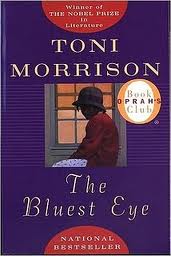
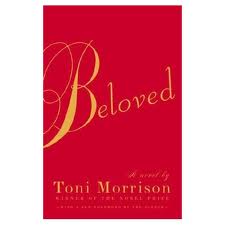
Toni Morrison is on my mind. The Advanced Placement English Literature Class (12th grade) has just finished reading her novel Beloved; the Advanced Placement English Language Class (11th grade) is currently offering The Bluest Eye. These are most certainly not written from a happy Ken and Barbie point of view. These novels are complex and difficult reads because the Nobel Prize winning Morrison makes the reader uncomfortable…yes, even unhappy.

In an interview on Oprah,  Morrison explained how she began her first novel, The Bluest Eye:

“Things were going very fast in 1965, so I decided I wanted to write a novel that was not a warning but was just literature, and I wanted to put at the center of that story the most helpless creature in the world—a little black girl who doesn’t know anything, who has never been center stage. I wanted it to be about a real girl, and how that girl hurts, and how we are all complicitous in that hurt. I didn’t care what white people thought, because they didn’t know anything about this. This was the age of ‘black is beautiful,’ and, well, yeah, that is certainly the case; however, let us not forget why that became a necessary statement.”

The Bluest Eye is set in Post-Depression America, 1941, in the author’s hometown of Lorain, Ohio.  Eleven year-old Pecola Breedlove, a black girl, longs to be a white child with blonde hair and blue eyes. In a particularly graphic scene, the reason the book is so controversial, she is raped and impregnated by her own father.  Much of the book centers on the ideal of beauty and Pecola’s inability to accept herself. She is exposed to the perfect life portrayed in the Dick and Jane series of reading primers at school which increases her conflict about her self-image as seen in an excerpt from The Bluest Eye:

 “I destroyed white baby dolls. But the dismembering of dolls was not the true horror. The truly horrifying thing was the transference of the same impulses to little white girls. The indifference with which I could have axed them was shaken only by my desire to do so. To discover what eluded me, the secret of the magic they weaved on others. What made people look at them and say, ‘Awwwww,’ but not for me.”

The other book, Beloved, is based on the true story of Margaret Garner, a runaway slave who crossed the frozen Ohio River to Cincinnati in January 1856 with her four children. Confronted by a slave catcher, Garner killed her daughter rather than have her returned to be a slave. In the novel, Sethe escapes with her newborn daughter, Denver, to meet up with her other three children, one of them the already-crawling? toddler who is known as Beloved. Sethe has 28 days of freedom where she is able to love her children for the first time:

“I was big, Paul D, and deep and wide and when I stretched out my arms all my children could get in between. I was that wide. Look like I loved em more after I got here. Or maybe I couldn’t love em proper in Kentucky because they wasn’t mine to love. But when I got here, when I jumped down off that wagon-there wasn’t nobody in the world I couldn’t love if I wanted to. You know what I mean?”

Soon after, the plantation owner School Teacher and a slave catcher arrive to claim their property, Sethe and her children. In an act of savage desperation taken in order to keep her children from a life of slavery, Sethe uses a saw to slice open the toddler’s neck , but she is prevented from killing her other children. In addition to this gruesome scene, the novel is also rife with rape, mutilations, and the supernatural. These elements  make its choice for a school curriculum as controversial as The Bluest Eye. However, both texts are often listed on the Advanced Placement Open Essay list, an indication that these books are exactly the kind of complex texts students should be reading. The demanding Advanced Placement prompts from past years are not answerable with less weighty books.

Teachers themselves struggle with complex and demanding texts, and the English Companion Ning often features posts from teachers who are looking for information on a topic or lesson plans on a text. There are always several posts about the use of Toni Morrison books in the high school curriculum. Many of these posts discuss the controversy these books cause for teachers who want to teach Morrison’s complex and compelling literature while addressing the concerns of  parents about the appropriateness of each novel’s content.

One teacher posted:

“I think it’s funny how we sometimes find things more shocking as adults than as kids.  I read The Bluest Eye in 11th grade and never thought about it being objectionable or age-inappropriate.  I actually read quite a bit of Toni Morrisson in HS.  As an adult, I think The Bluest Eye should be taught.  That said, any book with sensitive subject matter does need to be introduced in a thoughtful, open, and contextualized manner.”

While another offered a very balanced approach:

“Just want to mention that it is the parents’ responsibility to train up their children. It is not the responsibility of the school or the state. I worry that we teachers tend to forget that, making our relations with parents far more adversarial than they ought to be. Why not let the parents choose the appropriate novel for their child? Focus the classwork on skills that can be used with any novel, on practicing the thinking that will help students get through tough texts more independently, rather than on specific-novel content.

That said, strong instruction and discussion on what distinguishes great literature from not-so-great literature — literary fiction from commercial fiction, will help students see the difference between the great novels we English teachers want them to read and the … um, lightweight? novels they want to read.”

Morrison novels are demanding. They do not depict happiness. Their settings depict a world in stark contrast to the world of Ken and Barbie. While Ken and Barbie as fictional characters are perfectly formed, coiffed representatives of all that is perfect in the world, they have have not been marginalized as the fictional characters who people Morrison’s work; they have not experienced rejection, brutality, pain or suffering.

In the Oprah interview, Morrison attempts to explain a human’s want for acceptance by others but more importantly, by the self:

“I think a lot has changed since the ’60s in terms of self-image. But there’s still a lot of pain young girls feel because the bar is always being raised. The stakes are always higher….We don’t have the vocabulary to tell children what to value. We do say, “Oh, you’re so beautiful. Oh, you’re so pretty. Oh—that’s not really what we really ought to be saying. What do you tell a child when you want to say, “You are good, and I like that. You are honest and I like that. [Y]ou are courageous. I really like that. I really like the way you behave. I like the way you do yourself. Now. The way you are.’ That’s the vocabulary we need.”

Morrison’s admits that when she first started writing, she was writing for a different audience:
 “I guess I was just that arrogant. Nobody was going to judge me, because they didn’t know what I knew. No African-American writer had ever done what I did—none of the writers I knew, even the ones I admired—which was to write without the White Gaze. My writing wasn’t about them.”
 Morrison’s  The Bluest Eye and Beloved unapologetically stand in stark contrast to the world of Dick and Jane or Ken and Barbie. Her writing has received national and international praise for exactly that reason.

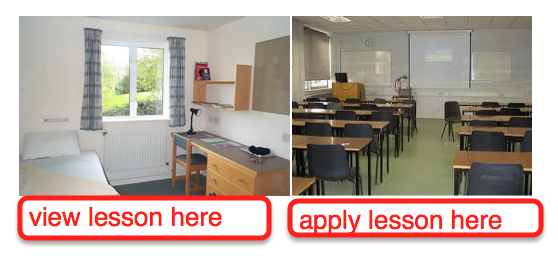
The wiki allows us to link students to resources on the web (texts, audio texts, websites) available 24/7 for Grade 9.

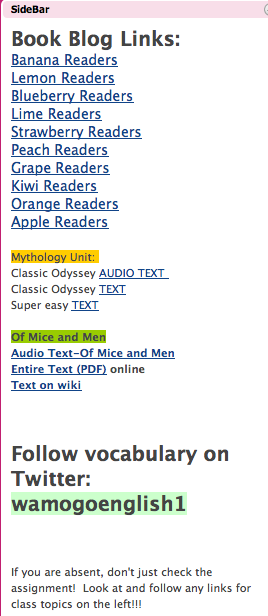
The English Department teachers operate in  “Wiki Wonderland” at Wamogo High School; all class materials for English classes, and other disciplines as well, for grades 7-12 are available 24/7 on our class wikis using the PBWorks platform.

Syllabus link for AP English Literature with University of Connecticut Early College Experience course-Grade 12

Our school does have the paid subscription based on the number of students assigned to each wiki so that there is an additional level of security for students, however, the use of a wiki does not require a subscription. There are numerous wiki platforms, (Google, Wetpaint, Wikispaces, etc) and most have free classroom editions with limitations on design and security features.

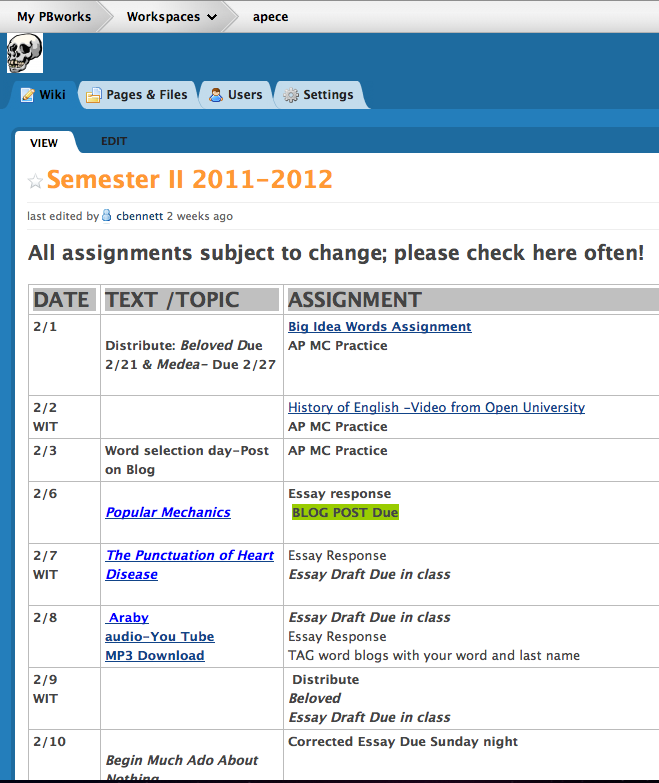
English Department teachers  use either the assignment page template or insert a table (see below) to post a schedule of activities by week, quarter, or semester.  We are able to link materials on any page in the wiki itself, to a link on the Internet or to a document that has been uploaded. The wiki also allows us to embed videos, audio clips, animations, pictures, and other widgits on a page; we often have students comment on these embedded masterial by responding directly on  the page.

A lesson or unit can be completely organized on a wiki page (directions, resources, responses) so that students may work independently, in or outside class. Organizing materials, pages and files, on the wiki for ease of use by student/parent  is probably the most challenging task for each teacher.

Using the wiki meant that we are moving towards a “blended classroom” of in class and online learning. For the past two years, we have been very happy with the wiki in class. Plus, we thought by using the wikis that we were “cutting edge”.
Then came the flipped classroom.
The flipped classroom is organized so content usually delivered in a classroom is posted as homework , and the homework given to provide students some practice with content is completed in class. This approach allows a teacher the opportunity to devote more time working with students rather than lecturing or demonstrating a particular skill.

So, English Department teachers are now trying to incorporate the flip. There are some challenges, however; English is not a “content driven” class. In fact, the skills a student is taught at the elementary level are the same  that are taught at the high school level: reading, writing, speaking, listening. The process of aquiring these skills in English is not so much a sequence, like a staircase, as it is a weave, like cloth. Students improve these skills of reading, writing, speaking, listening by exposure to increasingly complex  content. There are more challenging texts, more sophisticated vocabulary, and more rigor with grammar as the student moves through an eductional system.

A simile in the picture book Quick Like a Cricket is the same literary device as a simile in Arthur Miller’s Death of a Salesman, a theme in E.B. White’s Charlottes’ Web can be as universal as a theme from Dostoevsky’s  Crime and Punishment, and a rhyme scheme by Shel Silverstein can be as clever as a rhyme scheme by Shakespeare.  English is a discipline of warp (writing structure) and woof (writing style) that is centered on the application and practice of skills rather than the aquisition of a body of facts. The collection of information (content) belongs more to history, mathematics, science and social sciences.
That said, how does a flipped English classroom work? What can easily be flipped?

Currently, we are trying to develop grammar lessons into a flipped model. New grammar content can be created and/or uploaded for overnight viewing (adverbial clauses) as well as remediation (capitalization of the letter “I” when used as a pronoun). Materials placed online for the flipped classroom have the  added benefit of having materials available for review if a student forgets one of the rules in our complex language.

Since many of our students do less and less assigned reading for homework, our English Department teachers are dedicating more time in class to active reading, read alouds, and silent sustained reading in class. In a sense, we have flipped the reading activity to the classroom. However, providing instructional class time for reading means that a focus must be on having students responding to the texts effectively. At present, many responses to literature are begun in class, completed for homework and then peer- reviewed in class to prepare for the final polish before turning the response in the following day.

We have also organized our independent reading materials by unit (coming of age, people in conflict), and each book’s summary, book reviews, and a selection of passages from books have been placed online on the wiki so that a student may “shop” for a text outside the classroom rather than waste time perusing the classroom library looking for a book.

So far, those are the successes our teachers have had with the flipped classroom model; we will be experimenting this year with using the flip model for vocabulary, providing context materials for literature (not front-loading, however!), and promoting texts.

At present, I do not anticipate that the English classrooms in my department will be completely flipped, just as our English classrooms are not completely blended. Yet, the degree to which blended learning with resources on the wiki for instruction in and outside class is being influenced by the principles of the flipped classroom I cannot say. I do know that more and more of our instruction is taking place online, and because we are adopting the methods of blending or flipping instruction, teaching English in the 21st century means the teachers must be more flexible, almost gymnastic, than ever before.

In order to familiarize English teachers with the Common Core Language Arts Standards, education policy expert David Coleman has been making the rounds with sample lessons and explanations. A video taken in NY , Close Reading of Text: Letter from Birmingham Jail, Martin Luther King, Jr. from EngageNY on Vimeo, has been posted on the English Companion Ning with the caption, “David Coleman leads a sample exploration of a complex text utilizing strategies outlined within the six shifts in instruction.” The text he discusses is Martin Luther King’s Letter from a Birmingham Jail; the video takes 15 1/2 minutes to watch. One point he makes about extended close reading is particularly alarming. But first, a quick bio on David Coleman (supplied for seminar):

David Coleman is a Founding Partner of Student Achievement Partners, a non-profit  organization that assembles leading thinkers and researchers to design actions to substantially improve student achievement. Most recently, Mr. Coleman and Jason Zimba of Student Achievement Partners played a lead role in developing the Common Core State Standards in math and literacy. Mr. Coleman and Jason Zimba also founded the Grow Network – acquired by McGr aw-Hill in 2005 – with the mission of making assessment results truly useful to teachers, school leaders, parents, and students. Mr. Coleman spent five years at McKinsey & Company, where his work focused on health care, financial institutions, and pro bono service to education. He is a Rhodes Scholar and a graduate of Yale University, Oxford University, and Cambridge University.

Coleman is also on the board of directors of The Equity Project Charter School (TEP), a 480-student middle school in the Washington Heights neighborhood of New York City that opened in September 2009. The school has received much attention because of the  $125,000 salaries paid to teachers. The 2010-2011 results of NY English-Language Arts Assessment given to 5th graders saw a passing rate of  31.3%, below average for comparable schools. The school, however, has moved up 127 ranking points from 2009-2010, and its current standing in ELA assessment is 1972 out of 2291 NY state schools.

I think it is important to note that Coleman is not a teacher. He has not taught in a classroom.
Back to Letter from a Birmingham Jail.

Coleman spends a great deal of time using a New Criticism approach, which is defined at the Bedford St. Martin VirtuaLit website as one that, “…stresses close textual analysis and viewing the text as a carefully crafted, orderly object containing formal, observable patterns…New Critics are more likely than certain other critics to believe and say that the meaning of a text can be known objectively.” This marks a shift from Reader Response Criticism, defined by proponent Stanley Fish as recognizing that the reader is active, and that “Literature exists and signifies when it is read,and its force is an affective one. Furthermore, reading is a temporal process, not a spatial one as formalists assume when they step back and survey the literary work as if it were an object spread out before them.”

Paragraph by paragraph, Coleman analyzes the language and structure of King’s letter, occasionally suggesting  that the letter can be a jumping off point for further study into historical injustice or to Socrates. Exactly how a teacher positions the students to make the intellectual jump to recognizing the strategies of King’s moral argument is not explained in Coleman’s video.  Instead, Coleman offers his possible interpretations of King’s letter. He models a lesson he would give, but he is not providing a strategy. Strategy is a plan of action designed to achieve a vision; Coleman provides an example, not a plan of action. To be clear, critical thinking is a strategy and students need to have critical thinking skills. For example, at the Critical Thinking Community, there are eight elements of reasoning that could serve as strategy, a plan of action, for analyzing King’s letter:

  • What is the text’s purpose?
  • What questions does the text generate or try to answer?
  • What information is contained in this text to answer these questions?
  • What inferences are being made in the text?
  • What key concepts does the reader need to know when reading the text?
  • What assumptions can the reader make about the text (and its author, purpose)?
  • What are the consequences of having read this text?
  • Whose point of view is seen in the text? Whose point of view would be different?

I have not taught King’s letter, but I have taught challenging texts of similar length and complexity. I have taught Elie Wiesel’s 1999 speech to Congress The Perils of Indifference and George Orwell’s 1946 essay, Politics and the English Language. Both pieces were taught in conjunction with a work of fiction rather than “stand alone” pieces. Both texts took one or two periods to have students understand the purpose of the text and the information in the texts. I did not take students through all of the elements of reasoning; these were supplemental texts I chose to support fiction were we studying.

So when I heard Coleman’s position that a teacher should spend six to eight days on this letter, I was taken aback. Really? Six to eight days is two weeks in “school time”, the same amount of time I usually spend teaching the entire memoir Night by Elie Wiesel. Six to eight days represents the class time used for several grammar mini-lessons and two polished essays. Six to eight days represents a unit on (8) sonnets, or a unit on (5) short stories, or the in-class reading of three acts of Shakespeare’s Macbeth.

Again, I must reiterate that Coleman is not a teacher. He has not taught in a classroom.

Back to Letter from a Birmingham Jail.

The genius of King’s letter is how he combines the political and moral argument in an emotional appeal that is, like all great literature, immediately evident. I see the protracted dissection of his letter as akin to tearing a delicious muffin apart in order to reduce the muffin to its ingredients, all that is left are the (still delicious) crumbs. Furthermore, focusing so much attention on this one letter  could be construed as a little insulting to King. I sense he, like any author, did not intend for his work to be parsed in classrooms for such extended periods of time. Close reading is important, but inspection is another. Students generally are not interested in the minutiae of rhetorical composition. I also envision a cadre of dead American authors similarly frustrated rolling in their graves as students are forced to slog through weeks upon weeks of literature study…”Once upon a  midnight dreary…” .

In my classrooms, Coleman’s suggested time of processing extended reading over six to eight days would be met with frustration by many of my students, regardless of reading level. I speak from experience in the classroom where three days (reading, responding, discussing, and writing) in a 9th grade classroom spent on Edgar Allen Poe’s Cask of the Amontillado is sufficient; a fourth day would make them as mad as Montresor. Furthermore, his blithe remark that extended time will better allow all students to participate and make contributions again places the emphasis on time rather than on the engaging strategies that need to be in place.Yes, close reading is a skill, but that skill must be practiced with a multitude of texts. The application of close reading skills from one selection to another is where many students falter.  Strategies that improve a student’s close reading skills from one selection to another, from one genre to another, from one discipline to another should be the focus of teachers implementing Common Core standards. The disproportioned allotment of time to one text reduces the amount of time practicing with other texts. While Coleman could argue that a close reading of six to eight days would be taught only once in order to model close reading skills, the likelihood that students would replicate that lengthy  process on their own is unlikely.

A student’s level of appreciation of a text is still often tied to personal experience. Deep engagement with a text for student is,  as with many adults, a personal experience that cannot be forced. Coleman’s six to eight day formula may make a student aware of elements in a text but not necessarily personally engage in the same manner he espouses. His personal engagement with King’s letter is obviously one of reverence; his video explaining King’s letter borders on proselytizing. In comparison, King did that better-and he didn’t take six days.

“Why is every story we read in school so depressing?” lament my students, “Everyone dies!”

My response is usually a flip, “Because happy people don’t write great literature.”

I have always held the theory that great literature is born from discontent; that great literature finds its genesis in the mind of the outsider, that great literature is written from the margins. In other words, great literature reflects the real-life experiences of an author, and some of these life experiences can be miserable.

Generally, readers understand that they can slip into a narrative unbound by gender, age, or background. Literature is a way for readers to participate in an experience that may not otherwise be possible. Often, these experiences can be painful.

But is my theory correct?

There are many sites on the Internet that have compiled a “Top Ten” rating of literature, with many of the same titles included. One such list is posted on the TIME website. Occupying the #1 place with Anna Karenina AND the #3 place with War and Peace is Leo Tolstory. These titles certainly meet the criteria of “depression”; the first ends in suicide, the second ends in critiquing the nature of power in history. While it is unlikely that either of these titles would ever be taught in a high school, I have taught his novella The Death of Ivan Illyich with great success, and several of his short stories are included in world literature anthologies in our English classrooms.

So, was Tolstoy happy?

He was born in Russia, orphaned before the age of 12, and educated at home. He enrolled, but never graduated from the University of Kazan, and he served in the army during the  Crimean War. He wrote in his diaries, “I put men to death in war, I fought duels to slay others. I lost at cards, wasted the substance wrung from the sweat of peasants, punished the latter cruelly, rioted with loose women, and deceived men. Lying, robbery, adultery of all kinds, drunkenness, violence, and murder, all were committed by me, not one crime omitted, and yet I was not the less considered by my equals to be a comparatively moral man. Such was my life for ten years” ( Ch. VI)

He married Sofya (Sonya) Andreyevna Bers, and together they had 13 children, however, only 10 of them survived infancy. The year Anna Karenina was published, Tolstoy became depressed and suicidal. Six years later he wrote in his diary:

“I am now suffering the torments of hell: I am calling to mind all the infamies of my former life—these reminiscences do not pass away and they poison my existence. Generally people regret that the individuality does not retain memory after death. What a happiness that it does not! What an anguish it would be if I remembered in this life all the evil, all that is painful to the conscience, committed by me in a previous life….What a happiness that reminiscences disappear with death and that there only remains consciousness.”

His diaries were subject of great controversy; ownership was disputed until his death. The Online Literature website notes, “For as the last days of Tolstoy were playing out, he still at times agonised over his self-worth and regretted his actions from decades earlier. Having renounced his ancestral claim to his estate and all of his worldly goods, all in his family but his youngest daughter Alexandra scorned him.”

So, was Tolstoy’s state of happiness a factor in his writing? Do his life experiences support my theory that great literature come an author’s from painful life experiences? Given the evidence above, Tolstoy does meet the standard of having miserable moments in his life. Would he agree that that great literature comes from the pens of unhappy writers?

Perhaps the answer is one of empathy. A great writer demonstrates empathy in creating an experience for the reader. Which goes to my point made in the title; Ken and Barbie, or the Ken and Barbie “types”, do not write great literature because they lack empathy. Those perfectly formed, coiffed representatives of all that is perfect in the world have not been marginalized; they have not experienced rejection or have  been misunderstood. Instead, their very success depends on their unfamiliarity with loneliness, victimization, exploitation, pain and suffering. Ignorance is bliss, but ignorance on the part of a writer is also ignorance of the human condition, and great writers are not ignorant.

That is not to say that great writers are unhappy either, even Tolstoy.  He did understand the paradoxical nature of pain and sadness and reader enjoyment; he reveals an empathy born from experience for both. Consider his opening line for the magnificent, and tragic, Anna Karenina, “Happy families are all alike; every unhappy family is unhappy in its own way.” Sounds like a family living nowhere near Barbie’s penthouse.

NEWLY EDITED 12/29/12:
I hate Reader Response Theory, one that considers readers’ reactions to literature as vital to interpreting the meaning of the text.

CHANGED TO:
I hate how Reader Response Theory has been abused by standardized testing. Two most annoying questions for me in the Connecticut standardized testing for reading (CAPT-Response to Literature) are reader response based questions to a short story prompt:

  • CAPT #1:What are your thoughts and questions about the story? You might reflect upon the characters, their problems, the title, or other ideas in the story.
  • CAPT #4: How successful was the author in creating a good piece of literature?  Use examples from the story to explain your thinking.

After 10 years of teaching with this standardized test, I can recognize how many of my students struggle with these questions. Many lack the critical training gained from extensive reading experiences in order  to judge the quality of a text. Combine this lack of reader experience with the see-saw quality of the text on the exam year to year.  Since classic short stories such as those by Saki, Anton Chekhov, Kate Chopin, Stephen Crane, and Jack London, to name a few, are considered too difficult for independent reading by 3rd quarter 10th grade students, more contemporary selections have been used on the exam. For example, these stories in the past years have included Amanda and the Wounded Birds by Colby Rodowsky, Catch the Moon by Judith Ortiz Cofer, and a story written by Jourdan U Playing for Berlinsky published in Teen Ink. While some stories are well-written, many lack the complexity and depth that would generate thoughtful responses to a prompt that asks about “good literature.”  My students are in the uncomfortable position of defending an average quality story as good; the prompt promotes intellectual dishonesty.

So, I use a formula. I teach my students how to answer the first question by having them list their intellectual (What did you think?) and emotional (What did you feel?) reactions to the story. I have them respond by listing any predictions or questions they have about the text, and I have them summarize the plot in two short sentences. The formula is necessary because the students have only 10-15 minutes to answer this in a full page handwritten before moving to another question. The emphasis is one that is reader’s response; what does the reader think of the story rather than what did the author mean?

I teach how to answer the evaluation question much in the same way. Students measure the story against a pre-prepared set of three criteria; they judge a story’s plot, character(s) and language in order to evaluate what they determine is the quality of the story. Again, this set of criteria is developed by the student according to reader response theory, and again there is little consideration to author intent.

The newly adopted Common Core State Standards (CCSS) in Language Arts is designed differently. The  focus is back on the text; what the reader thinks is out of favor. For example, in three of the ten standards, 10th grade students are required to:

  • Analyze how complex characters (e.g., those with multiple or conflicting motivations) develop over the course of a text, interact with other characters, and advance the plot or develop the theme;
  • Determine a theme or central idea of a text and analyze in detail its development over the course of the text, including how it emerges and is shaped and refined by specific details; provide an objective summary of the text;
  • Cite strong and thorough textual evidence to support analysis of what the text says explicitly as well as inferences drawn from the text.

Please note, there is nothing in the language of the standards that asks what the student thinks or feels about the text.

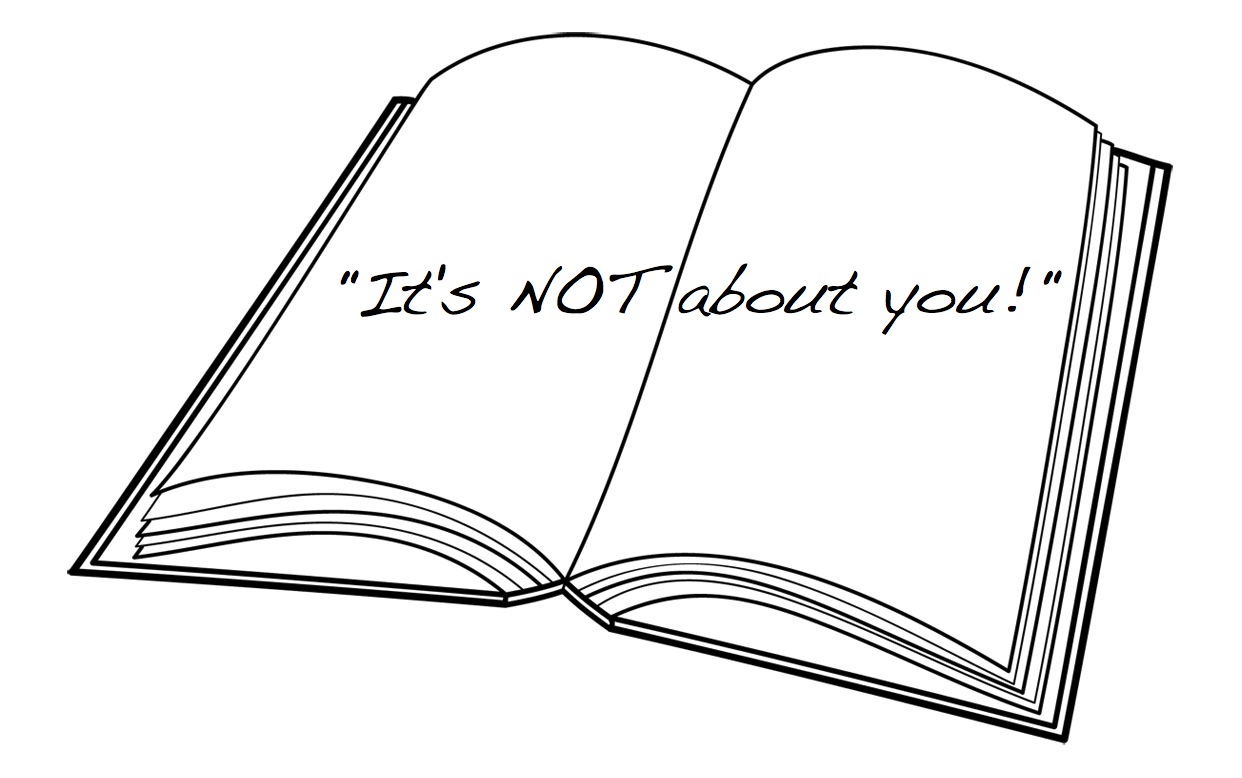
In an article titled, “How Will Reading Instruction Change When Aligned to the Common Core?” on The Thomas B. Fordham Institute website (1/27/2012), Kathleen Porter-Magee  discusses the shift from the student centered response to the CCSS  “challenges to help students (and teachers) understand that reading is not about them.”

Porter-Magee  describes how David Coleman, one of the architects of the CCSS ELA standards, is promoting the close reading of texts, sometimes over extended periods of several days. The article notes that currently, “teachers often shift students’ attention away from the text too quickly by asking them what they think of what they’re reading, or how it makes them feel. Or by asking them to make personal connections to the story.” Coleman states that, “Common Core challenges us to help students (and teachers) understand that reading is not about them.” Instead, he advocates the practice of close reading, a practice that  “challenges our overemphasis on personal narrative and personal opinion in writing classrooms.”

In addition to the movement away from reader response criticism, the CCSS will be upgrading the complexity of the texts. Porter-Magee notes that,

“Of course, there’s only value in lingering on texts for so long if they’re worthy of the time—and that is why the Common Core asks students to read texts that are sufficiently complex and grade-appropriate. Yes, such texts may often push students—perhaps even to their frustration level. That is why it’s essential for teachers to craft the kinds of text-dependent questions that will help them break down the text, that will draw their attention to some of the most critical elements, and that will push them to understand (and later analyze) the author’s words.”

In other words, the quality of the texts will be substantively different than the texts used in the past on the Response to Literature section of the CAPT. This should make the response about the quality of text more authentic; a genuine complex text can be analyzed as “good literature.” How the more complex text will be used in testing, however, remains to be seen. A student trained in close reading will require more time with a complex text in generating a response.

I confess, the movement away from reader response is a move I applaud. A student’s response to a complex text is not as important in for the CCSS as what the text says or what the author intended, evidence will supplant opinion.

However, I am very aware that the momentum of the every swing of the educational pendulum brings an equal and opposite reaction. Swish! Out with reader response. Swoop! In with close reading of complex texts. Students,this swing is not about you.

Beware the Ides of March!
March Madness!
Mad as a March Hare!

Why so much warning about March?
Well, here in Connecticut, our students are preparing for the Connecticut Mastery Tests (CMT) in grades 3-8 and the Connecticut Academic Performance Test (CAPT) in grade 10 which are given every March. While every good teacher knows that “teaching to the test” is an anathema, there is always that little nagging concern that there should be a little practice in order to anticipate performance on a standardized test. So, we “practice” to the test.

In English, 10th grade students participate in a Response to Literature section of the test where they read a selected fiction story (2,000-3,000 words; RL 10th) and respond to four questions that ask:

  • a student’s initial reaction;
  • to note a character change or respond to a quote;
  • to make a connection to another story, life experience, or film;
  • to evaluate the quality of the story.

Unfortunately, an authentic practice for this test is time consuming, requiring 70 minutes which includes the reading of the story and the four essays, roughly a full hand-written page response to each question. Needless to say, our students do not like multiple practice tests for the CAPT, so developing the skills needed to pass the Response to Literature must be addressed throughout the school year.

When practice time does arrive,  students can be “deceived” into CAPT practice through technology. We have been trying two abbreviated practice approaches using our class netbooks where students actively read a text using hyperlinks or use quiz/test taking software. In these practice assessments the student responses are typed and shorter in length, but still cover the same questions. A hyperlinked test practice, including the sharing of results, can be done in one  40 minute class period.
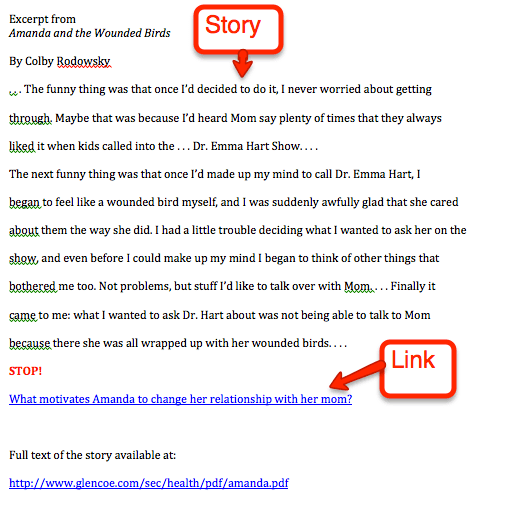
In the first approach, we select a short story that can be read in under 15 minutes and embed questions at critical points in the text that are tied directly to the Response to Literature questions. The students then respond to these questions as they read. The easiest software to use in creating a hyperlinked text is Google Documents using the “form” option to create individual questions. Each question’s URL link can be hyperlinked at specific moments in the text. An example is seen below. Multiple choice , scale or grid question are alternate selections that can be embedded in a story in order to provide a quick snapshot of a group’s understanding by looking at the “show summary of responses” option once the assessment is complete. There are many short stories in the public domain which can be posted on a site such as Google Docs for  student access in order to not conflict with copyright laws.

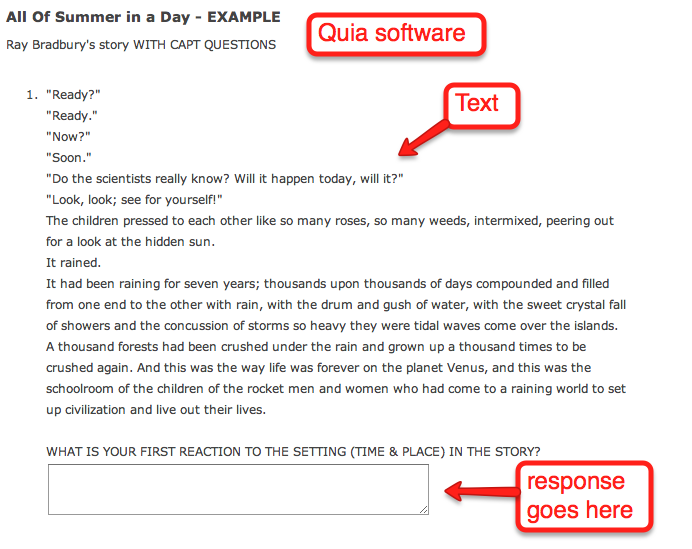
The second approach uses quiz and test taking software, such as Quia, where a teacher can paste sections of the text with question posed at the end of each section. Ray Bradbury’s All of Summer in a Day  (under Creative Commons license) is one story we are currently using for CAPT practice next week; the practice test (section seen below) can be taken at http://www.quia.com/quiz/3525412.html

The use of hyperlinks to monitor student understanding or to practice a procedure that will be helpful in a standardized test is not difficult to implement. Teachers are able to choose the kinds of questions and the placement of questions at critical sections of a text, and students like the ability to respond as they read in short answers rather than in practice essays.

While there is nothing that can be done to stop the onslaught of tests that come in March, the embedded hyperlink provides ways to satisfy that urge to practice and still engage the students.  You can even try a hyperlink response to a text by clicking here!

See? Wasn’t that easy?

The question started innocently enough. An assignment for a class I am taking offered through The Critical Thinking Community required that I integrate one of the elements of reasoning in a lesson. I chose the element of purpose and decided to ask my 9th grade students what was the purpose of reading a non-fiction essay ,”My Mother”, by Amy Tan. Several students dutifully raised their hands.

To know about her mother?”
“It’s a memory?”
“To remember what her mom said?”

Their responses were predictable and did not sound thoughtful; they sounded like they were guessing. I hate playing “Guess What the Teacher Wants to Hear”, so I shifted the question: “What is the purpose of reading an essay?”

Hesitation. Some disconcerted looks. A few timid hands.

“To read?”
“To understand what’s a good essay?”

I must have looked a little frustrated. “Why are you here?” I demanded.

Blank stares.

“Well, what is the purpose of English class? Why are you here?”

Then it hit me. They really had not given a thought as to why they were in English. I mean, they know what English class is, they have been in English every year they have attended school-nine years to date. They looked perplexed.

“Because, we are forced to come,” said Chris.
“Yes, we have to come,” agreed Mike.

They shifted nervously in their seats.

“That’s not purpose. That’s a result of someone else’s purpose,” I replied.

“To learn….(student voice trails off)…English?”

So, I took the cup of popsicle sticks labeled with each student’s name. “What is the purpose of English Class?” I asked each student after I called out a name. One by one they offered suggestions:

  • “….to learn…how to…write”
  • “…to learn how… to read?”
  • “…to learn about the comma?”
  • “…so we can go to college.”
  • “…to learn what is in a book…characters.”

After each response,  I asked the next student “Do you agree with that reason?” before I asked “What is the purpose of English class?”

As we went around the room, I explained there could be “no repeats“; the responders had to think more critically about what I was asking. Slowly, their responses became more sophisticated. Their responses did not have the sound of a question. They were answering my repeated question as a statement. They began to stir and leaned forward in interest trying to see who could come up with the “answer”.

  • “To learn about how characters are like people”
  • “To experience stories that we cannot really be in”
  • “To read and write about how we are all connected.”
  • “To be able to write so that other people can understand what we are saying and maybe believe what we write.”

They started to raise their hands to adding new ideas to this brainstorming sessions. They wanted to give the correct answer….to stop my interrogation. Honestly,  I did not have an answer. I had no idea where this exercise was going, I was simply letting them critically think about why they came into my class day after day. They were suddenly engaged and eager to answer. At some level, they understood the importance of English class, they just had not thought about the purpose. In defining the purpose, they suddenly understood the purpose of my original question. I went back and asked, “What was the purpose of Amy Tan’s essay?”

  • “She is feeling guilty and she wants to make it up to her mom.”
  • “Her mother was important to her, and now that her mother has dies, she wants to tell others about how they should appreciate their mother.”
  • “Regret is hard, and she is living in regret like so many people who make mistakes when they are young…this is a confession.” 

My spontaneous shift  from asking about an essay to the larger topic  of why they were in English demonstrated how important the element of purpose is  to teaching. My next step will be to have students internalize the question, “What is the purpose of this _______(book, essay, poem, article, assignment, class)?” on their own, every day, semester after semester.

In the courtroom, the saying is “Never ask a question if you don’t know the answer.” But in education, we ask questions as a means to discover the answer. The Critical Thinking Community website states, “We must continually remind ourselves that thinking begins with respect to some content only when questions are generated by both teachers and students. No questions equals no understanding.”

So go ahead and ask, “What’s the purpose of English class?” Get the students thinking.